Breaking the AI Myth: Why Human Translators Will Always Be Essential

[Sponsor’s guest post]

This article will take a deep dive into the misconception that AI will replace human translators. It will provide data and insights into why AI can never fully replace the nuanced understanding and cultural knowledge that only humans bring to translation.

Breaking the AI Myth: Why Human Translators Will Always Be Essential

The rise of artificial intelligence (AI) has led to a widespread belief that human translators are on their way out, destined to be replaced by intelligent algorithms. But is this really the case? 

In this article, we’re going to debunk this myth, explaining why human translators are still and always will be essential. We’ll explore the nuances of translation that require a human touch. You’ll also see how AI is enhancing the role of professional linguists instead of replacing them.

The rise of AI in translation

AI translation technology has advanced from simple rule-based systems to sophisticated Neural Machine Translation (NMT), making translation faster and more accessible. Tools like Google Translate and DeepL offer quick, often accurate translations across many languages.

Despite these improvements, AI still falls short in understanding context, cultural nuance, and emotion. As Rachelle, Head of AI at Tomedes, says, “AI has transformed translation but can’t replace the cultural and contextual insights humans bring.” Human translators remain essential for adding the depth that AI alone cannot achieve.

AI and human translators’ collaboration can enhance the quality

Many think AI and human translators are in competition, but the best results happen when they work together. Picture AI as the rhythm in an orchestra, setting the basics, while human translators are the soloists, adding depth and nuance.

In translation, AI can handle repetitive tasks like drafting translations or processing large volumes of text, freeing human translators to focus on creativity, context, and emotional tone. For instance, AI might translate a technical manual, while a human ensures that safety warnings are adapted to each culture’s urgency and seriousness.

This partnership boosts efficiency for freelancers and in-house teams. It lets translators concentrate on making language vibrant and meaningful.

The Case for Free AI Tools in Translation

Free AI tools are transforming the translation industry by providing advanced technology at no cost, enabling smaller players to compete with larger Language Service Providers (LSPs).

Benefits of Free AI Tools:

  • Cost Savings: Freelancers and small businesses can reduce expenses by using free tools like MachineTranslation.com, allowing them to be more productive without the high costs of traditional software.
  • Accessibility: These tools provide small players with the same technology as large LSPs, enabling them to deliver high-quality translations and compete effectively.
  • Efficiency: Free AI tools automate repetitive tasks, letting translators focus on complex aspects of translation, increasing both productivity and quality.
  • Scalability: Small businesses can easily expand their capacity, using AI for first drafts and humans for refinement, managing higher demand without compromising quality.
  • Inclusivity: Free AI tools remove financial barriers, making advanced technology accessible to all and fostering a more inclusive industry.

How Tomedes is leading the way in free AI translation tools

Tomedes is setting a new standard with free AI-powered translation tools that boost efficiency without financial strain. Tools like MachineTranslation.com and AITranslator.com streamline repetitive tasks, letting translators focus on high-quality refinement. Freelancers and small translation companies now have the tech to compete with large Language Service Providers (LSPs), efficiently handling high-volume projects and serving global clients.

Our free AI translation tools empower freelancers and small companies to produce initial drafts quickly, especially for large projects like website translations, while human review ensures cultural accuracy and quality. However, while AI is valuable for routine tasks, human oversight remains essential for specialized or nuanced content. Translators should use AI tools as aids, not replacements, especially for complex projects that demand cultural and emotional precision.

As AI technology evolves, free tools will offer even more sophisticated support. By balancing AI’s speed with human expertise, translators can deliver accurate and resonant work, ensuring the best outcomes for clients and pushing industry standards forward.

How AI improves translation efficiency and reduces operational bottlenecks

Translation projects often face bottlenecks, especially in high-volume, multilingual tasks. Here, AI can greatly improve efficiency. By automating initial drafts, AI reduces timelines from days to minutes, giving translators more time to refine accuracy. Project managers can quickly assign drafts, speeding up workflow and ensuring consistency.

Corporate localization teams also rely on AI for efficiency, especially when translating large volumes like product descriptions across many languages. AI handles the initial translation, allowing human translators to refine it for cultural fit and brand tone. This blend of AI speed and human skill results in faster, more accurate, and cost-effective translations that meet deadlines without compromising quality.

The unmatched value of human cultural insight and emotional understanding

Human translators stand out for their cultural insight and ability to convey emotion. Language reflects culture and history, and while machines can translate words, they often miss the emotional depth. For example, “It’s raining cats and dogs” means heavy rain, something a human understands while AI might misinterpret without context.

Human translators excel at capturing the right tone and adapting content for cultural relevance. In business emails or customer support, they ensure the tone is suitable—professional yet empathetic. In literature, translators bring creativity to make the work resonate, capturing nuances that AI cannot. For ads, human translators adjust humor and references to fit regional norms, ensuring messages land appropriately without offending.

Why human oversight is critical in addressing AI’s limitations

AI translation tools have undeniably advanced, but they still have significant limitations that necessitate human oversight. Here are some of the most critical challenges of AI in translation:

1. Mistranslations with serious consequences

AI tools can create mistranslations with serious consequences, especially in healthcare and law. Accurate translation of patient info, dosage instructions, or legal terms is vital. Mistakes here could lead to incorrect treatments, legal issues, or regulatory problems, risking lives and businesses. Human oversight is crucial for accuracy and safety.

2. Inability to understand evolving language trends

Language is always changing, with new slang and expressions constantly emerging, especially from social media. Human translators adapt to these shifts faster than AI, which often lags behind. This quick adaptation is crucial in fields like marketing and media, where relevance is key. AI struggles with evolving language, so its translations may not connect well with modern audiences.

3. Difficulty with ambiguity

Many languages have words with multiple meanings, and AI often struggles to pick the right one without context. For example, “bank” can mean a financial institution or a river’s edge. Without context, AI might choose the wrong meaning, leading to confusion. Human translators use intuition and context to ensure accurate and clear translations, avoiding costly mistakes.

4. Lack of cultural sensitivity

AI can’t grasp cultural nuances, which are essential in content like marketing, literature, and PR. Human translators ensure content is culturally appropriate, resonating with audiences and avoiding offense. For example, an ad slogan might work well in one culture but be confusing or offensive in another. Only human translators can adapt content to be effective and respectful across cultures.

5. Limited ability to convey emotional tone

Language conveys emotions, intent, and tone, not just words. AI tools may translate words accurately but often miss the original emotional tone, especially in literature, poetry, and marketing. A heartfelt message might come across as robotic, losing its impact. Human translators capture the intended emotion, ensuring the message resonates with the audience.

6. Challenges with specialized terminology

In fields like law, medicine, engineering, and finance, precise translation of specialized terms is essential. AI tools may struggle with complex, industry-specific vocabulary. While AI can help with initial drafts, only expert human translators ensure correct, consistent terminology. Misinterpreting a technical term could lead to misunderstandings, compliance problems, or safety risks.

7. Contextual awareness

AI lacks true contextual understanding. While it has improved through machine learning, it still can’t match human comprehension. Context is crucial for translating idioms, metaphors, and unique phrases. Human translators use their experience, cultural knowledge, and context to ensure translations capture the original message accurately.

8. Ethical considerations and bias

AI systems, trained on large datasets, can sometimes learn and reflect biases, leading to biased or inappropriate translations on sensitive topics like gender, race, or culture. Human translators can spot and correct these biases, ensuring translations are fair and sensitive. Relying only on AI risks perpetuating stereotypes or causing unintentional harm.

Conclusion

AI has transformed translation, making it faster and more cost-effective, especially for basic tasks and large volumes of text. However, human translators remain essential, bringing cultural understanding, emotional intelligence, and the ability to convey the true essence of the original message. At Tomedes, we combine AI’s efficiency with human expertise to offer tailored language solutions that meet unique needs. 

*******

Become a sponsor or have your guest post featured.

Show your support of Translator Fun. Donate now.

Celebrate International Translation Day

Coffee day for translator
Translation day means coffee day
Buy Now Button

Purchase code: Coffee

On this special day, we celebrate a profession that bridges cultures, connects people, and makes the world a smaller place—Happy International Translation Day! Today is all about recognizing the hard work, dedication, and skill you all bring to the table (and the coffee shop, let’s be honest!).

As you go about your day, take a moment to celebrate the incredible impact you have on communication. Whether you are transforming complex legal documents into accessible language or helping a business navigate international waters, your expertise is invaluable.

Why not take a little break today to exchange cards with your fellow language enthusiasts? A simple gesture can brighten someone’s day and strengthen those essential connections within our community.

Speaking of coffee, it’s no secret that many translators and interpreters rely on a steady stream of caffeine to power through those late-night deadlines and endless glossaries. So, in honor of this special day, let’s raise our mugs (or cups, or thermoses) to one another and celebrate our shared love for language—and coffee, of course!

In the spirit of camaraderie and caffeine, the next round is on me. Just make sure you don’t spill it while you’re translating!

Cheers to all of you, and happy International Translation Day! Let’s keep translating the world, one sip at a time!

Drink up.

Buy Now Button

Purchase code: Coffee

********

Become a sponsor or have your guest post featured.

You can also send a small donation to show your support and encourage Romina to keep creating fun stuff. Donate now.

Vote for Translator Fun: Best Translation Blog Nominee

Vote for translator fun
Translator Fun has been nominated as one of the best translation blogs

I’m thrilled to share some exciting news with you all—this blog, Translator Fun, has been nominated for the ProZ.com Community Choice Awards 2024 in the category of Best Translation Blog!

This recognition means the world to me, and it’s all thanks to this amazing community of interpreters, translators, and language enthusiasts who have made this blog what it is today.

Back in 2011, when I published the first cartoon on this blog, I did not even dare to imagine it would get this far.

Why Vote for Translator Fun? If you’ve enjoyed the content, tips, and insights shared on Translator Fun, this is your chance to show your support. Whether you’ve been entertained by the humorous takes on translation mishaps or found value in the content created for you, your vote would be appreciated.

How to Vote: Voting is simple and only takes a few seconds. You don’t have to vote in every category—just skip to the ones that matter to you. Here’s how you can cast your vote:

  1. Visit the voting page: Click here to vote.
  2. Scroll to the Best Translation Blog category and select Translator Fun.
  3. Send your vote!
  4. Enter a valid email.

Every vote counts, and your support will help us reach even more translators, interpreters, and language lovers out there. Let’s keep the fun in translation going strong!

Thank you so much for being part of this journey. Your enthusiasm and support inspire me to keep creating content that resonates with this wonderful community.

Happy translating (and voting)!

Warm regards,
Romina Bona
Creator of Translator Fun

You can send a small donation to show your support and encourage Romina to keep creating fun stuff. Donate now.

Empowering Interpreters: The Courage and Stamina Behind the Job

Interpreters deserve compliments
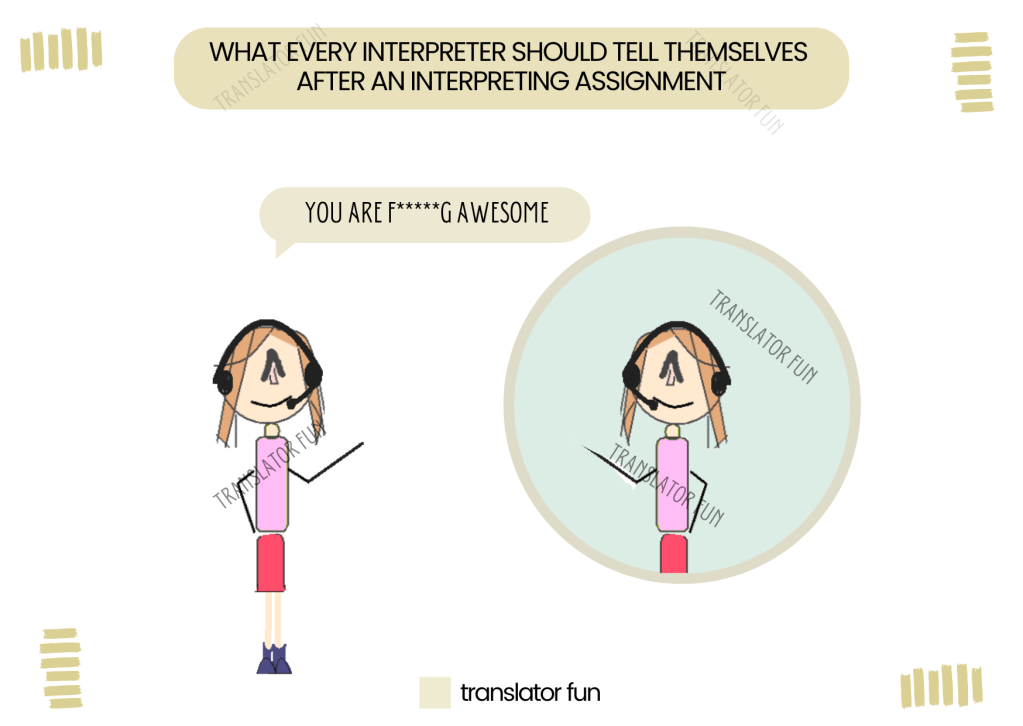
What every interpreter should tell themselves
Buy Now Button

Purchase code: F*** AWESOME

I’ve just completed a four-day interpreting assignment for the WIKIMANIA 2024 event in Katowice, Poland, organized by FOSSASIA. I had the honor of interpreting via streaming at the Ohrid Spanish room. The event was magnificent covering many interesting topics from technology, community health, research, legal & advocacy, governance & strategy, and so on. Useful information related to all the project pages on MetaWiki such as Wikimedia, Meta, MediaWiki, Wikimedia Commons, Wikipedia, Wiktionary, Wikinews, Wikiquote, Wikibooks, Wikiversity, Wikisource, Wikivoyage, Wikijunior, Wikispecies, Wikifunctions, Incubator, and Sep11wiki.

After the four-day interpreting experience I shared with one of my closest friends, Sole, and with Diego, a professional young colleague from Chile, I could not help but wonder how we managed to do that.

I never get tired of telling people that interpreters are gifted people who do an extraordinary job. Diverse skills and qualities required for the job: it takes courage to sometimes face the unknown. It takes stamina to keep up with the speakers’ pace. It takes determination to do it right. It takes perseverance to keep doing it no matter what goes around. It takes hard work and preparation to reduce the occurrence of surprises. It takes resilience to overcome the challenges ahead. It takes so many skills and traits that each of us should remind ourselves over and over again that we are f* awesome!

My fellow interpreters, bravo!

*******

#Ad Also visit my store on Amazon here https://www.amazon.com/shop/translatorfun

**Note: As an Amazon Associate I earn from qualifying purchases.

*******

Do you like Translator Fun? You can become a sponsor or have your guest post featured.

Unique Wedding Card for Translators | Special Gift Ideas

A translator at a wedding
Wedding cards for translators
Buy Now Button

Purchase code: WEDDING

Do you know a translator who is about to tie the knot? This card may be just the right present to congratulate them on the special occasion.

Translators can overlook a wide range of faults, but never a typo. Right?

Send this card to the bride and groom-to-be translators to help them relax in preparation for the big day.

********

Become a sponsor or have your guest post featured.

You can also send a small donation to show your support and encourage Romina to keep creating fun stuff. Donate now.

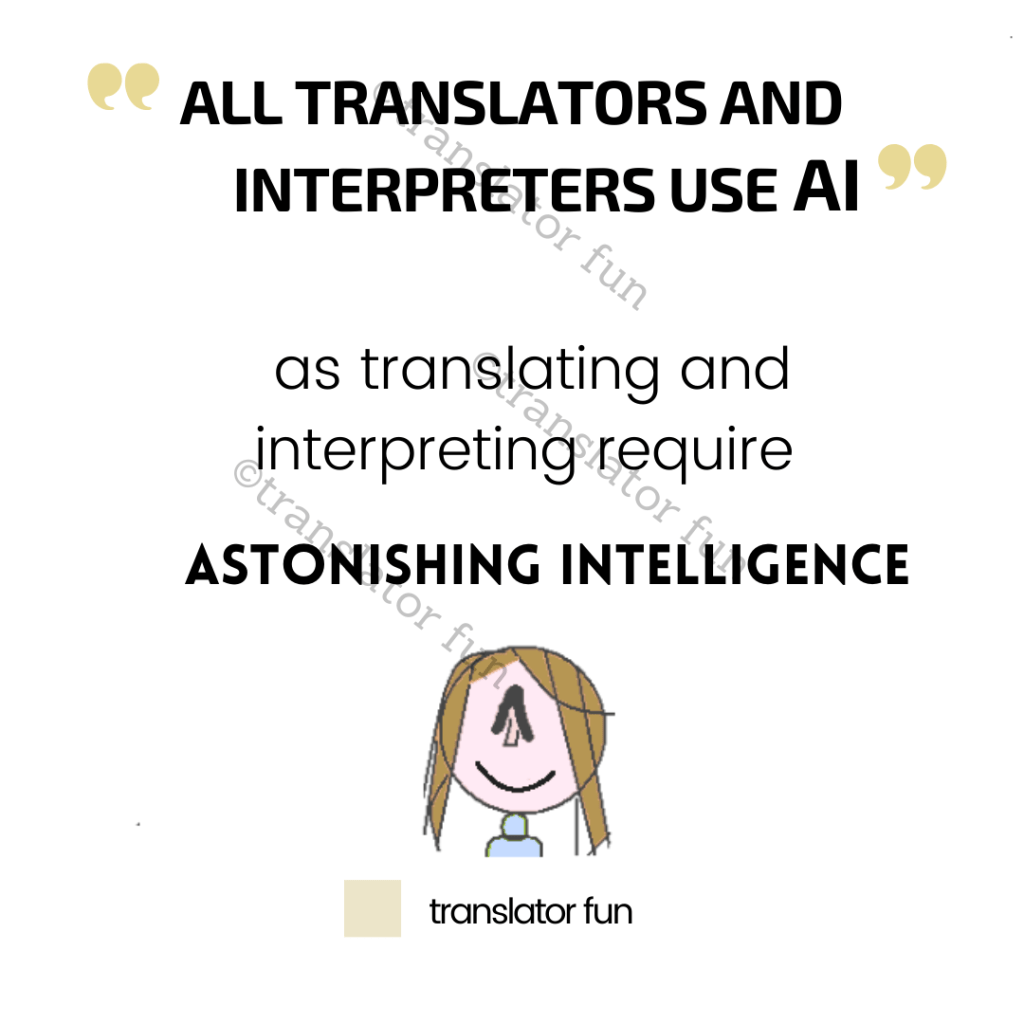
100% of translators and interpreters use AI

translating and interpreting require AI
AI is inherent in all translators and interpreters.
Buy Now Button

Purchase code: AI

There! I’ve said it. I believe 100% of translators and interpreters use their AI to work. Being a translator or an interpreter requires intelligence that can be described as astonishing or awe-inspiring. The experience of inhabiting two or more worlds simultaneously is awe-provoking. Translators and interpreters can see the world in one language and then switch to a different language to convey what they’ve just seen, read, and heard.

The more I think about it, the prouder I get. As I see it, AI is inherent in all translators and interpreters. Don’t you agree?

********

You can also send a small donation to show your support and encourage Romina to keep creating fun stuff. Donate now.

Bridging Language Barriers: The Art and Humor of Translation and Attestation

Professional translation agency in Türkiye
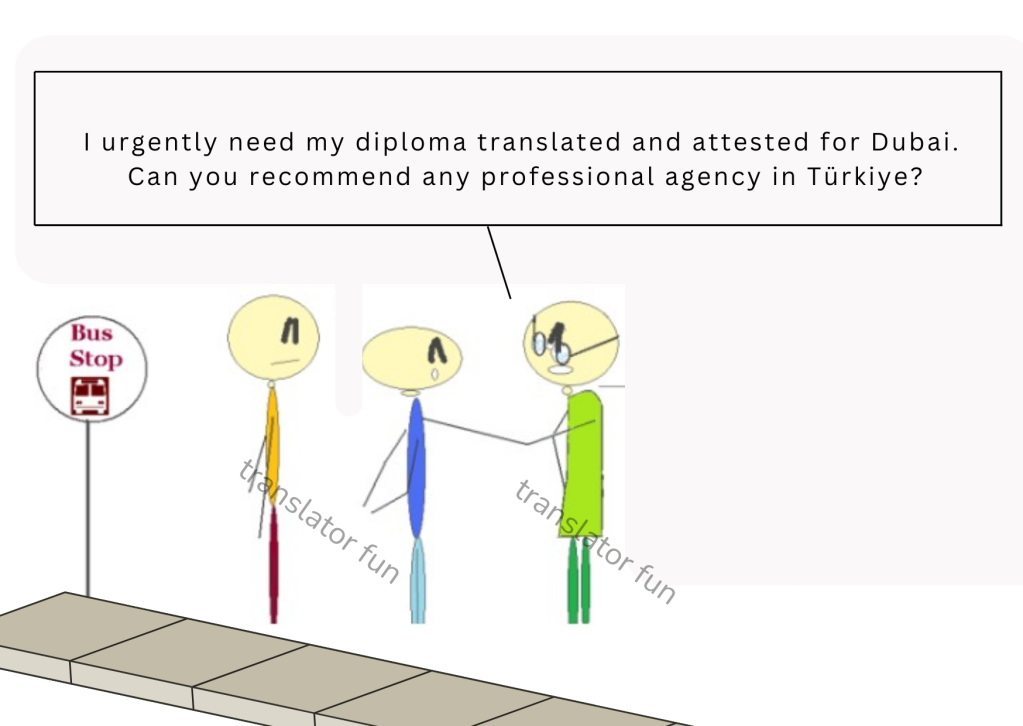
How to have your documents translated and attested for Dubai.

[Sponsor’s guest post]

In a world where language can be as tricky as deciphering ancient hieroglyphs, Professional translation agencies stand as your linguistic Rosetta Stone. From translating medical jargon to legalese, they’ve got you covered—and they do it with a smile!

The Serious Business of Translation

Imagine you’re at a Turkish bazaar, trying to buy a rug but ending up with a goat. Miscommunication can lead to hilarious yet frustrating situations. Turkish Translation Agency ensures you get the right rug (or whatever you’re after) by providing precise translations. Their certified translators work with languages as diverse as Turkish and Swahili, adhering to the highest standards to ensure your documents are spot-on.

The Magic of Attestation

Need your diploma validated in Dubai? Or perhaps your marriage certificate authenticated in Saudi Arabia? Think of attestation as the international stamp of approval, including apostille in Turkey. Turkish Translation & Attestation Agency makes this process as smooth as a perfectly brewed Turkish coffee. They handle the nitty-gritty of embassy requirements, so you don’t have to sweat the details.

Notarized and Certified Translations: No Joke!

Here’s a little joke: Why did the document go to the notary? To get stamped, of course! But in all seriousness, certified and notarized translations are crucial for legal and official documents. Turkish Translation & Attestation Agency ensures these translations meet global standards, whether it’s for an Apostille or consulate verification.

Fast and Furious (But in a Good Way)

Speed is essential when you need a translation yesterday. Turkish Translation & Attestation Agency offers a lightning-fast turnaround without compromising on quality. Their efficient process, including multiple stages of proofreading, guarantees that your translations are delivered error-free and on time.

Why Trust Turkish Translation Agency?

  1. Certified Professionals: Accredited and experienced.
  2. Affordability: High-quality services that won’t break the bank.
  3. Speedy Delivery: Quick, reliable, and accurate.
  4. Multilingual Mastery: Expertise in numerous languages.

In the end, navigating the world of translation and attestation doesn’t have to be like translating an alien language. With Turkish Translation & Attestation Agency, you can rest assured your documents are in capable hands. So, whether you’re translating a love letter or a legal document, remember: they’ve got your back, one word at a time.

*******

Become a sponsor or have your guest post featured.

Human Touch: Why Certified Interpreters Trump Automated Solutions

[Guest post]

In the ever-evolving landscape of communication where borders are increasingly becoming blurred, the need for effective language interpretation has never been more critical. While technology has made remarkable strides in automated translation solutions, there remains an undeniable truth: human touch, particularly in the form of certified interpreters, holds unparalleled value. Join us as we explore why, in the realm of language interpretation, the skills, empathy, and cultural understanding of certified interpreters continue to outshine automated alternatives.    

Navigating Nuances Beyond Words:

Language is not just a string of words, but a living, breathing entity imbued with cultural nuances, emotions, and context. Certified interpreters possess the ability to navigate these intricate layers, going beyond literal translations to capture the essence of communication. Automated solutions, while effective, often struggle to grasp the subtleties of human expression, leading to potential misunderstandings and misinterpretations.

Cultural Sensitivity and Contextual Understanding:

Certified interpreters are trained not just in languages but also in cultural dynamics. They understand the importance of context, cultural nuances, and the impact of non-verbal cues. In contrast, automated solutions lack the depth of cultural insight required for accurate interpretation, potentially leading to miscommunication in sensitive situations such as legal proceedings, healthcare consultations, or international business negotiations.

The Art of Active Listening:

Effective communication is a two-way street, and skilled interpreters excel not only in translating words, but also in active listening. They pick up on tone, emotions, and unspoken cues, ensuring a more comprehensive and accurate interpretation. The human touch in active listening is a nuanced skill that contributes significantly to successful communication, fostering understanding and building trust.

Adaptability in Dynamic Situations:

Language interpretation often occurs in dynamic, fast-paced environments where quick thinking and adaptability are crucial. Certified interpreters bring a level of agility that automated solutions struggle to match. Whether navigating technical jargon, legal terminology, or emotional conversations, human interpreters can adjust their approach in real-time, ensuring seamless communication in various scenarios.

Preserving Privacy and Confidentiality:

Certain interactions require a high degree of privacy and confidentiality, such as legal consultations or medical appointments. Certified interpreters adhere to strict ethical standards and confidentiality protocols, providing a level of trust that automated solutions may struggle to guarantee. Human interpreters prioritize the protection of sensitive information, creating a secure environment for communication.

Holistic Approach to Communication:

Interpreting goes beyond mere language conversion; it involves understanding the cultural context, emotions, and intentions behind the words. Certified interpreters adopt a holistic approach, recognizing the humanity in communication. Automated solutions, lacking emotional intelligence, may miss crucial nuances, resulting in a transactional rather than relational communication experience.

The Ethical Dimension:

Certified interpreters operate within a framework of professional ethics, including impartiality, accuracy, and cultural sensitivity. They navigate ethical dilemmas with finesse, ensuring fair and unbiased interpretation. In contrast, automated solutions lack the moral compass and discernment required for ethical decision-making in nuanced situations.

Conclusion: The Irreplaceable Human Element in Interpretation

While technology continues to reshape the way we communicate, human touch remains irreplaceable in the realm of language interpretation. Certified interpreters bring not just linguistic proficiency but also empathy, cultural understanding, and adaptability to the table. In critical situations where effective communication is paramount, the art of interpretation thrives in the hands of certified professionals. As we navigate the future, it’s clear that while technology can enhance efficiency, the human touch in interpretation will continue to be a beacon guiding us through the complexities of global communication.

******

Do you like Translator Fun? Become a sponsor or have your guest post featured.

Valentine’s Day cards for translators and interpreters

Valentine’s Day is around the corner, and translators and interpreters also deserve some love, right? These Valentine’s Day cards are an excellent present to send to your colleagues.

Happy Valentine’s Day!

Buy Now Button

When I’m with you… V1

Would you marry me? V2

Stop typing… V3

I like you so much… V4

See more Valentine’s Day cards here.

******

Do you like Translator Fun? Become a sponsor

You can also send a small donation to show your support and encourage Romina to keep creating fun stuff. Donate now.

Unveiling the Power of Certified Translations: A Guide for Businesses

[Guest Post]

In today’s interconnected global marketplace, effective communication is the key to success. For businesses navigating international waters, the importance of accurate and reliable translations cannot be overstated. This is where certified translations come into play, serving as the linchpin for seamless global interactions.

Understanding the Need for Certification:

Certified translations go beyond mere linguistic conversion; they bear the stamp of approval from a qualified professional attesting to their accuracy. This becomes especially crucial in legal, business, and official documentation where precision is paramount. From contracts and patents to regulatory filings, the consequences of inaccuracies can be far-reaching.

Ensuring Accuracy in Global Ventures:

Imagine the scenario: your company is on the verge of a major international deal, and contracts are being translated. A slight error in translation could lead to misunderstandings, legal complications, and financial losses. Certified translations act as a safety net, providing businesses the assurance that their documents are accurately translated and free from any errors that could jeopardize their ventures.

Navigating Regulatory Compliance:

Different countries have distinct regulatory requirements, and compliance is non-negotiable. Whether you’re expanding your business overseas or dealing with international clients, certified translations ensure that your documents meet the necessary legal standards. This is particularly crucial in industries such as healthcare, finance, and law, where the stakes are high, and adherence to regulations is paramount.

Global Expansion Made Seamless:

For businesses eyeing global expansion, language barriers are a common stumbling block. Certified translations pave the way for a smoother expansion process by ensuring that your marketing materials, product documentation, and other business collateral are accurately translated while maintaining the intended message and brand integrity.

Conclusion:

As businesses continue to explore new horizons, the power of certified translations emerges as a critical factor in their success. By investing in professional translation services backed by certifications, businesses can unlock the full potential of global collaboration, confident that their messages are accurately conveyed across linguistic and cultural boundaries.

******

Do you like Translator Fun? Become a sponsor or have your guest post featured.