Apostille, Legalization, Notarization and Attestation: What’s the Difference?

[Sponsor’s Guest post]

You have your diploma translated. The notary has stamped it. Someone tells you that you still need an apostille. Then the embassy mentions legalization.

Sound familiar?

For translators, agencies, and clients working with official documents, terms such as notarization, apostille, legalization, and attestation often appear in the same conversation. They are related, but they do not mean the same thing.

Understanding the difference can save time, money and more than a few frustrating trips between notaries, government offices and consulates.

First Things First: Translation Is a Separate Step

Translation converts the content of a document from one language into another.

A certified or sworn translation may include the translator’s declaration, signature or stamp, depending on the country and the authority receiving the document.

But translation itself does not automatically authenticate the original document.

That is where notarization, apostille and legalization may enter the picture.

What Is Notarization?

Notarization is performed by a notary public or another authority with similar powers under national law.

In translation workflows, notarization may confirm the translator’s signature or certify a document or copy according to the applicable local procedure.

A notarized translation is therefore not the same thing as an apostilled document.

The key point is simple:

Notarization takes place within a national legal system. Apostille or legalization is generally concerned with using a document across borders.

What Is an Apostille?

An Apostille is a certificate issued under the 1961 Hague Apostille Convention.

The Convention was designed to simplify the use of public documents between participating countries. Instead of going through the traditional diplomatic or consular legalization chain, an eligible document can receive a single Apostille from a competent authority in the country where the document originates.

An Apostille authenticates the origin of the public document — for example, the capacity of the person who signed it and, where appropriate, the identity of the seal or stamp.

It does not certify that the contents of the document are true.

This distinction matters.

An apostilled diploma, for example, has not been academically “approved” by the Apostille. The Apostille relates to the authenticity of the document’s official origin.

What Is Legalization?

Traditional legalization is generally used when the Apostille Convention does not apply to the document or destination country.

Depending on the countries involved, legalization may require several steps involving national authorities, ministries of foreign affairs, embassies or consulates.

This is why legalization can be more complicated than an Apostille.

The precise procedure varies significantly from one country to another, so there is no universal legalization chain that works for every document.

For documents issued in Türkiye and intended for use abroad, professional guidance on apostille and legalization in Türkiye can help determine which route is appropriate for the destination country and document type.

And What Does “Attestation” Mean?

“Attestation” is one of the most confusing words in international document processing because its use varies by country.

In some jurisdictions, attestation is used broadly to describe authentication of a document. In others, it may refer specifically to embassy, consular or foreign ministry authentication.

For example, clients dealing with Gulf countries frequently encounter phrases such as:

  • embassy attestation,
  • consular attestation,
  • Ministry of Foreign Affairs attestation,
  • educational certificate attestation.

For this reason, translators should never assume that “attestation” always means one specific procedure.

The receiving authority’s requirements should be checked first.

Apostille vs. Legalization: The Main Difference

A useful rule of thumb is:

Apostille = simplified authentication under the Hague Apostille Convention.

Legalization = another authentication procedure, often involving diplomatic or consular authorities.

But even this rule has exceptions depending on the document, country and authority receiving it.

Always verify the actual requirements before beginning the process.

Which Documents Commonly Go Through These Procedures?

Documents frequently submitted for translation and international authentication include:

  • university diplomas and transcripts,
  • birth certificates,
  • marriage certificates,
  • criminal record certificates,
  • powers of attorney,
  • court documents,
  • company registration documents,
  • commercial agreements,
  • medical documents,
  • certificates issued by public authorities.

The required process can differ even for two documents being sent to the same country.

A diploma and a commercial power of attorney, for example, may follow different procedures.

Translation Before or After the Apostille?

Another classic question.

Unfortunately, the answer is not always “translation first” or “apostille first.”

In one procedure, the original document may first receive an Apostille and then the complete document — including the Apostille — may be translated.

In another, the translated document may need notarization or additional authentication.

The correct order depends on:

  • the issuing country,
  • the destination country,
  • the type of document,
  • the receiving authority,
  • the language requirements.

This is why checking the process before translating or notarizing everything can prevent unnecessary costs.

Common Mistakes to Avoid

Clients often assume that every document going abroad needs an Apostille. That is not necessarily true.

Other common mistakes include:

  • obtaining an Apostille when the destination requires consular legalization,
  • translating only the document but not the Apostille or attached certification,
  • completing notarization before checking the receiving authority’s requirements,
  • confusing a certified translation with document authentication,
  • assuming that a procedure used for one country will work for another.

For translators and translation agencies, asking one simple question early can prevent most of these problems:

Where will this document be used, and for what purpose?

The Value of Coordinating Translation and Authentication

International document processing often involves several professionals and authorities. Translation may be only one stage of the journey.

A specialized agency can coordinate the language and authentication requirements before the document begins moving through the process.

The Turkish Translation & Attestation Agency (TTAA) works with certified and notarized translations as well as apostille, consular legalization and document attestation procedures for documents used internationally.

The objective is not simply to translate the words on the page, but to prepare the document in the form required by the authority that will ultimately receive it.

Final Checklist

Before starting an international document procedure, confirm:

  • Which country will receive the document?
  • What authority will receive it?
  • Is translation required?
  • Does the translation need certification or notarization?
  • Does the document qualify for an Apostille?
  • Is consular legalization required instead?
  • Which step comes first?
  • Does the Apostille or legalization page also need translation?

A few minutes spent answering these questions can save days of unnecessary processing.

Because in international document work, the hardest part is sometimes not translating the document.

It is making sure the document takes the right journey after the translation is finished.


Do you like Translator Fun? Become a sponsor or have your guest post featured.

Free Tools for Translators: Choose Your Favorite Panda

Panda logo
free tools for translators

Today I wanted to introduce you to a handy set of simple and useful tools created by Rafael López Sánchez, a fellow translator who loves pandas. These tools are designed to make your daily work easier. They’re completely free, require no installation, and work directly in your browser.

Below is a list of them with brief descriptions.

poanda: a simple tool for editing .po files.

pandaterm: a simple TBX/CSu glossary editor.

pandoria: a simple tool to edit and align translation memories.

subpandaASS: your tool for creating subtitles.

subpandaTM: a tool for editing and translating subtitles. Import an .srt file and a video to start working. If you wish, you can work with a TMX translation memory and a TBX glossary, which you can import or create from scratch.

supandaAUTO: AI-powered automatic transcription and subtitling tool.

subpandaQA: una potente herramienta para detectar errores en archivos de subtítulos SRT con estilo.

pandascript: a powerful tool to detect errors in SRT subtitle files with style.

diffpanda: a tool to compare texts and generate change reports quickly and easily.

pandatimer: a tool for managing your time easily.

charpanda: a simple free app for counting characters.

calpanda: a free tool for generating invoices.

In addition, through traduversia, Rafa offers a free course with unlimited access to learn how to use each tool in more detail. You can sign up for the course here.

No excuses! I’ve already signed up.

See you there.


Do you like Translator Fun? Become a sponsor or have your guest post featured.

The Deadline Curse: Why Your Computer Hates Pressure

Translator’s paradox
Every translator knows that as soon as the project deadline looms, a strange, universal curse descends upon our hardware.
Buy Now Button

Purchase code: Paradox

We’ve all been there: the project is 99% done, the deadline is mere hours away, and suddenly your screen freezes. It’s the Translator’s Paradox—a universally accepted truth that the stability of your technology is inversely proportional to your time remaining. It’s a certainty in our field—the closer it gets to the deadline, the more likely your computer will start acting weird. Suddenly, the CAT tool freezes during the final QA check, the browser crashes with twenty source tabs open, or worse, your perfectly reliable operating system decides now is the ideal time to download a major update. This isn’t just bad luck; it’s a cosmic joke played on those who work best under pressure, reminding us that backing up your work ten minutes ago was, perhaps, a slightly better idea than waiting until the very last second.

Because misery loves company (and a little humor). Purchase this card to instantly connect with your fellow translators and remind them that they are not alone in the tech-meltdown mayhem.

See more cards here,

*******

Do you like Translator Fun? You can become a sponsor or have your guest post featured.

Show your support of Translator Fun. Donate now.

AI in the Translation Sector: Friend, Foe, or Secret Teammate?

[Sponsor’s guest post]

🤖 AI in the Translation Sector: Friend, Foe, or Secret Teammate?

The translation industry has always been a fascinating crossroads of language, culture, and technology. From the earliest days of bilingual dictionaries to the advent of machine translation, every new tool has reshaped the profession. Now, Artificial Intelligence (AI) is the latest player to step onto the stage—and it’s hard to ignore its impact.

🚀 The Rise of AI in Translation

With the rapid development of neural machine translation systems, AI has moved beyond clunky word-for-word renderings. Tools like DeepL, Google Translate, and countless custom-built engines can now produce surprisingly fluent drafts. For many, this feels like magic: input text on one side, receive a nearly publish-ready version on the other.

But is it really that simple? Not quite. AI can certainly speed up workflows, but it struggles with nuance, cultural sensitivity, and the highly specific requirements of certified or notarized translations. Anyone who has asked AI to handle a complex legal contract or a medical report knows it: the results can range from amusing to alarming.

🎭 Translators in the Age of AI

So, what does this mean for professional translators? Instead of pushing human experts aside, AI is becoming more of a teammate. Think of it as the enthusiastic intern: fast, eager, and tireless—but in desperate need of supervision.

Human translators bring what AI cannot replicate:

  • Contextual understanding (knowing when “bank” means a financial institution vs. the edge of a river).
  • Cultural sensitivity (catching idioms, humor, and subtle tones).
  • Legal and official accuracy (ensuring certified translations meet notarial and governmental standards).

In short, AI drafts, but translators perfect.

🏛️ When Machines Meet Ministries

One area where AI’s limits become crystal clear is in official translation and attestation. Governmental approvals, apostille procedures, and embassy verifications demand precision, certification, and human accountability. No AI-generated stamp is going to pass at the Ministry of Foreign Affairs.

Agencies like the Turkish Translation & Attestation Agency (TTAA) emphasize this balance beautifully. While technology assists in efficiency, it’s human expertise—and the trusted agency’s official seals—that guarantee documents are legally valid abroad.

😂 A Lighter Note

Let’s be honest: every translator has had at least one good laugh at AI’s expense. Some classics from community forums include:

  • “Marriage certificate” translated as “wedding coupon.”
  • “Seal of approval” rendered as “animal of applause.”
  • And the eternal favorite: mistranslations that read more like abstract poetry than legal text.

These moments remind us that while AI is impressive, it still has a long road before replacing the artistry of human translation.

🌍 Looking Ahead

The future isn’t about humans versus machines—it’s about collaboration. Translators who embrace AI as a productivity tool will thrive, freeing themselves from repetitive tasks and focusing on higher-value work. Clients, meanwhile, will continue to rely on professional translation agencies like TTAA for the gold standard: translations that are fast, accurate, and officially recognized worldwide.


✨ Final Thought:
AI may speak in many tongues, but only human translators know how to listen between the lines.

*******

Become a sponsor or have your guest post featured.

Show your support of Translator Fun. Donate now.

Yoga for translators | Day 9 – 21-Day Perfect Health Challenge with Deepak Chopra

Centering Thought: “My outer world reflects my inner world.”
Mantra: SAT CHIT ANANDA

Yoga for translators and interpreters
SAT CHIT ANANDA | My outer world reflects my inner world.
Buy Now Button

Purchase code: SACHITAN

Spanish version

On Day 9 of the 21-Day Perfect Health Challenge, we’re reminded of a powerful truth: our external reality mirrors our internal state. Cultivating peace, clarity, and joy within naturally radiates into the world around us.

The mantra SAT CHIT ANANDA translates to existence, consciousness, and bliss—the essence of our true selves. As you meditate on these words, allow yourself to connect with the calm and wholeness already within you. From that inner harmony, your outer experiences begin to shift.

Take a moment today to reflect: what does your outer world reveal about your current mindset, emotions, or beliefs? What small shift can you make within to create more alignment?

To support today’s practice, I recommend the Day 9 yoga pose card. It features the centering thought, a grounding yoga posture, and a beautiful design to keep your focus clear and inspired throughout the day.

Click here to purchase the card and bring Day 9’s wisdom to life through mindful movement.

Remember, your inner light shapes your outer life. Let today be a step toward radiance.

*******

Do you like Translator Fun? You can become a sponsor or have your guest post featured.

Yoga for translators | Day 8 – 21-Day Perfect Health Challenge with Deepak Chopra

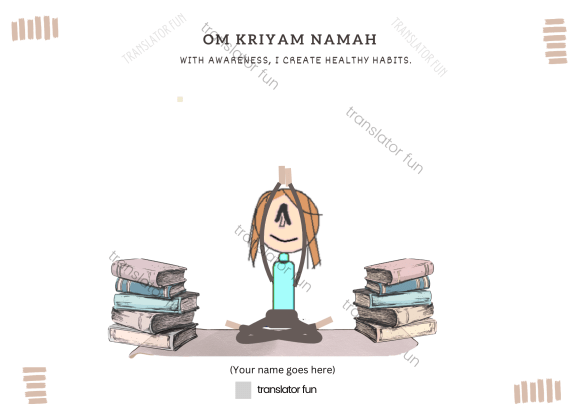
Centering Thought: “With awareness, I create healthy habits.”
Mantra: OM KRIYAM NAMAH

Translator practicing yoga to achieve perfect health
OM KRIYAM NAMAH | With awareness, I create healthy habits.
Buy Now Button

Purchase code: OMKN

Spanish version

Welcome to Day 8—a day focused on cultivating habits that support true well-being. Today’s centering thought reminds us that lasting change begins not with force, but with awareness.

When we slow down and observe our daily choices—what we eat, how we move, how we speak to ourselves—we step into our power as conscious creators. OM KRIYAM NAMAH means “My actions are aligned with cosmic law,” inviting us to act from a place of balance, intention, and inner wisdom.

Even small habits, when done mindfully, become rituals of healing. Whether it’s taking a deep breath before a meal or going for a walk instead of scrolling on your phone, awareness is the spark that transforms routine into nourishment.

To deepen today’s practice, we recommend the Day 8 yoga pose card—a simple, elegant tool that features today’s centering thought, a corresponding pose, and a visual anchor to support your journey.

Click here to purchase the card and bring today’s intention into movement and mindfulness.

Let awareness be your guide today—your habits will follow.

*******

Do you like Translator Fun? You can become a sponsor or have your guest post featured.

Yoga for translators | 21-DAY of Perfect Health Challenge by Deepak Chopra — Day 5 OM ANANDA NAMAH

Freelance translator doing Yoga - Warrior I pose
I flow in rhythm with my mind and body

Here’s day 5 of Deepak Chopra’s 21-Day Perfect Health Challenge for translators and interpreters. Day 5’s mantra is “OM ANANDA NAMAH”, and the centering thought for this meditation is “I flow in rhythm with my mind and body.”

Send this card to your colleagues to help them relax after a tough day.

Nemaste.

Spanish version

Buy Now Button

Purchase code: OM ANANDA NAMAH

*******

#Ad Check this perfect kit I recommend for your next yoga session by clicking here https://www.amazon.com/shop/translatorfun

You can also stop by the shop and check the lists I curated for you.

**Note: As an Amazon Associate, I earn from qualifying purchases.

*******

Do you like Translator Fun? You can become a sponsor or have your guest post featured.

Yoga for translators | 21-DAY of Perfect Health Challenge by Deepak Chopra — Day 3

Freelance translator doing Yoga- Tree pose
My mind and body are in perfect sync.

Here’s day 3 of the 21-Day of Perfect Health Challenge by Deepak Chopra for translators and interpreters. Day’s 3 mantra is “SHAM”, and the centering thought for this meditation is “My mind and body are in perfect sync.”

Send this card to your colleagues to help them relax after a tough day.

Nemaste.

Buy Now Button

Purchase code: SHAM

Spanish version

*******

#Ad Check this perfect kit I recommend for your next yoga session by clicking here https://www.amazon.com/shop/translatorfun

You can also stop-by the shop and check the lists I curated for you.

**Note: As an Amazon Associate, I earn from qualifying purchases.

*******

Do you like Translator Fun? You can become a sponsor or have your guest post featured.

Marketing Your Translation and Interpretation Business with a Powerful Quote by Warren Buffett

Buy Now Button

Purchase code: Value

As a freelance translator or interpreter, you know that your work goes far beyond simply converting words from one language to another. You’re not just a conduit for communication; you’re a bridge between cultures, a voice for the voiceless, and an integral part of business and international relations. But in a competitive industry, ensuring that your skills are truly valued by potential clients can be challenging.

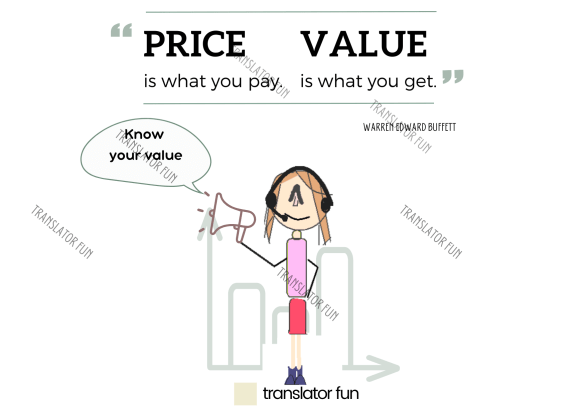
Warren Buffett, one of the world’s most successful investors, once said: “Price is what you pay, value is what you get.” This simple yet profound statement has powerful implications for how you market yourself as a professional translator or interpreter.

Understanding the Difference: Price vs. Value

Let’s break this down. As a freelancer, you might often hear clients focus on price—asking for a discount or shopping around for the “cheapest” option. But here’s the critical distinction you should keep in mind:

  • Price is what you pay. This is the number on the invoice, the sum of your hourly rate or per-word fee.
  • Value is what you get. This is where your expertise, experience, and skills shine through. It’s the precision of your translations, the nuance you bring to your interpretations, and the reliability and cultural understanding you offer.

When clients focus on price alone, they often miss the true value that comes from working with an experienced and highly skilled professional. As a translator or interpreter, your value lies not just in the number of words you translate or the number of hours you work, but in the way you ensure that communication is clear, accurate, and culturally relevant.

Know Your Worth, and Don’t Settle for Less

Too often, translators and interpreters undervalue their services in an attempt to win over clients with lower rates. While being competitive is important, cutting your rates too much can send the wrong message: that your expertise doesn’t deserve to be compensated fairly.

Instead, I encourage you to embrace the mindset of providing value. Understand that your skills are an asset to your clients’ success. Whether you’re translating marketing materials, interpreting at a medical conference, or assisting with legal proceedings, your work profoundly impacts your clients’ ability to communicate effectively and avoid costly misunderstandings.

How Can You Market Your Value?

To successfully market your translation or interpretation business, it’s essential to communicate the value you bring to the table—not just your price. Here are a few strategies to do so:

  1. Craft a Value-Oriented Pitch – Instead of saying, “I charge X per hour,” try positioning yourself as a problem-solver: “I help businesses communicate effectively in [language] markets, ensuring accurate and culturally relevant translations that boost customer engagement.”
  2. Highlight Your Expertise – Share your background, specialized knowledge, and the results you’ve achieved. Have you worked with major brands, translated complex documents, or interpreted for high-stakes events? Let your clients know!
  3. Share Testimonials – Nothing speaks to your value more than satisfied clients. Collect testimonials that emphasize the quality and impact of your work.
  4. Set Clear Boundaries – Make it clear that you won’t compromise on quality for the sake of price. Stand firm in your rates and explain why the value you provide justifies them.
  5. Offer Packages, Not Discounts – Rather than lowering your rates, create service packages that emphasize the comprehensive nature of your work and the long-term benefits clients will receive by working with you.

A Simple Step to Market Your Business

Now that you understand the importance of communicating your value, I want to share a simple yet powerful tool that can help you stand out: the Value Marketing Card. This card allows you to distill your expertise and your unique value proposition into a concise, visually appealing format that you can easily share with potential clients.

By using the Value Marketing Card, you’re not just telling clients what you do; you’re showing them the true value of working with you. This card serves as a reminder that your services are an investment—one that will pay off in clarity, accuracy, and cultural understanding.

Ready to elevate your freelance business and market your true value? Purchase your Value Marketing Card today and start presenting yourself as the high-quality professional that you are. Don’t let clients focus only on price—let them understand the lasting value you bring to the table.

By knowing your worth and using smart marketing tools like the Value Marketing Card, you’ll attract the right clients who are willing to pay for the top-notch services you provide. After all, when clients see your value, the price becomes a secondary consideration.

Take the First Step Today!

Take charge of your business and shift the focus from price to value. Purchase your Value Marketing Card now and start showcasing the incredible skills you bring to every translation and interpretation project.

Your clients deserve the best, and so do you.

*******

Do you like Translator Fun? You can Become a sponsor or have your guest post featured.

Show your support of Translator Fun. Donate now.

How the Tomedes Pre-Translation Toolkit Enhances Translation Accuracy

[Sponsor’s guest post]

Accurate translations are essential for clear communication across languages, which is important for global business, cultural exchange, and international teamwork. Even a small mistake in translation can cause serious problems like misunderstandings, damage to reputation, or legal trouble. To tackle these issues, Tomedes created the Pre-Translation Toolkit, a complete solution to make translations more accurate and efficient.

By addressing common pain points early in the translation process, the Pre-Translation Toolkit offers a structured approach to tackling the complexities of multilingual content. This article explores this toolkit’s components, features, and benefits, highlighting how it redefines the standard for professional translations.


What Is the Tomedes Pre-Translation Toolkit?

The Pre-Translation Toolkit is a comprehensive suite of tools designed to optimize the initial stages of translation projects. These tools address essential pre-translation tasks, including language identification, topic analysis, terminology extraction, and complexity assessment. By automating these processes, the toolkit significantly reduces the likelihood of errors and ensures that translation workflows are both efficient and reliable.

The toolkit is not limited to professional translators; it benefits localization experts, content creators, and businesses preparing materials for international audiences. With its versatile features, the toolkit adapts to the unique requirements of various industries, providing tailored support for projects of all sizes.


Components of the Toolkit

1. Language Detector

Identifying the language(s) present in a source text is fundamental to initiating an accurate translation. The Language Detector quickly and reliably determines the language, eliminating any guesswork.

Applications:

  • Businesses managing multilingual customer interactions can ensure accurate responses in the correct language.
  • Software platforms requiring localization can align projects with appropriate translation engines or experts.

Key Impact: 

This tool streamlines the project setup phase, reducing delays caused by language misidentification and ensuring that the text is matched with the appropriate translator or machine translation engine.


2. Topic Detection Tool

Understanding the subject matter of a source text is essential for ensuring the translation aligns with the intended context. The Topic Detection Tool analyzes the content and identifies its primary subject, making it easier to assign projects to specialized translators or MT engines.

Industries Benefited:

  • Healthcare: Translating medical reports and clinical research documents accurately requires subject matter expertise.
  • Finance: Financial documents, including annual reports and compliance records, demand precision, and contextual understanding.
  • Legal Services: Contracts, legal briefs, and court documents must adhere to strict terminologies and legal conventions.

By pinpointing the topic, this tool ensures that the translator or engine selected has the necessary expertise, reducing errors and maintaining relevance.


3. Key Terms Glossary

Consistency in terminology is a hallmark of high-quality translation, particularly in technical fields or branding projects. The Key Terms Glossary identifies critical terms in the source text and provides a framework for ensuring their consistent use throughout the project.

Why It’s Important:

  • Industries like pharmaceuticals, engineering, and software development rely on precise terminology to maintain clarity and avoid misinterpretations.
  • Brand-specific terminology ensures that marketing materials retain their intended message and tone across languages.

Example: 

A software company launching a global campaign can ensure that technical terms, product names, and user interface labels remain consistent across all translations.

4. Source Text Checker

Poorly written source texts often lead to inaccuracies in translation. The Source Text Checker reviews the original text for grammatical errors, ambiguous phrasing, and structural inconsistencies, offering actionable feedback to improve its quality before translation begins.

Benefits:

  • Reduces misunderstandings caused by unclear or erroneous source material.
  • Saves time by addressing potential issues early, and minimizing revisions later in the process.

This tool ensures that the source text provides a solid foundation for translation, ultimately improving the accuracy and fluency of the final output.

5. Translation Difficulty Checker

Translation projects vary significantly in complexity. The Translation Difficulty Checker analyzes the text’s linguistic challenges, such as idiomatic expressions, technical terminology, and sentence structure, to recommend the most suitable translation approach.

Applications:

  • AI Translation: 

Suitable for routine documents such as internal reports or emails.

  • Human Transcreation: 

Necessary for creative content, such as marketing campaigns or literary works.

Key Outcome: 

By matching the complexity of the text with the right translation method, this tool ensures both cost efficiency and high-quality results.


How the Toolkit Increases Translation Accuracy

  • Streamlined Preparation

The Pre-Translation Toolkit automates labor-intensive tasks, reducing the manual effort required during the preparation phase. Translators can focus on refining the content rather than resolving preliminary issues, leading to faster and more accurate results.

Outcome: 

Automation not only saves time but also ensures that the translation process starts on a strong foundation.

  • Improved Consistency

Consistency in translation is critical, especially for large-scale or collaborative projects. Features like the Key Terms Glossary help maintain uniformity across all aspects of a project.

Example: 

A global brand managing campaigns in multiple regions can ensure that its messaging remains coherent and culturally appropriate in all target languages.

  • Faster Turnaround Times

By streamlining the preparation phase, the toolkit enables quicker project completion without sacrificing quality.

Impact: 

Businesses can meet tight deadlines with confidence, ensuring that their materials are both accurate and timely.

  • Enhanced Collaboration

The insights provided by the toolkit can be shared among teams, ensuring alignment on key terms, topics, and project goals before translation begins.

Use Case: 

A localization team preparing a multilingual marketing campaign can align on key terminology and tone, reducing the likelihood of inconsistencies.


Traditional Workflows vs. Toolkit-Driven Processes

Traditional translation workflows often involve manual reviews and preparations, which can be time-consuming and prone to errors. Common challenges include:

  • Identifying ambiguous or poorly written source text.
  • Ensuring consistent use of terminology across documents.
  • Addressing formatting or structural issues in the source material.

The Tomedes Pre-Translation Toolkit automates these tasks, offering a scalable and efficient alternative to traditional methods:

  • Traditional Processes: 

Time-consuming, inconsistent, and prone to human error.

  • Toolkit-Driven Processes: 

Automated, precise, and adaptable to diverse project needs.


Conclusion

The Tomedes Pre-Translation Toolkit represents a significant advancement in translation preparation, addressing common challenges with innovative tools that prioritize accuracy and efficiency. By integrating solutions like the Language Detector, Topic Detection Tool, and Translation Difficulty Checker, the toolkit empowers translators, localization experts, and businesses to deliver high-quality translations tailored to their needs.

Whether preparing marketing materials for global audiences, translating technical manuals, or localizing software, the Pre-Translation Toolkit simplifies and enhances the process, ensuring reliable results every time.

Explore the Pre-Translation Toolkit to see how it can elevate your translation projects, improving consistency, accuracy, and collaboration at every stage.

*******

Become a sponsor or have your guest post featured.

Show your support of Translator Fun. Donate now.