🤖 AI in the Translation Sector: Friend, Foe, or Secret Teammate?
The translation industry has always been a fascinating crossroads of language, culture, and technology. From the earliest days of bilingual dictionaries to the advent of machine translation, every new tool has reshaped the profession. Now, Artificial Intelligence (AI) is the latest player to step onto the stage—and it’s hard to ignore its impact.
🚀 The Rise of AI in Translation
With the rapid development of neural machine translation systems, AI has moved beyond clunky word-for-word renderings. Tools like DeepL, Google Translate, and countless custom-built engines can now produce surprisingly fluent drafts. For many, this feels like magic: input text on one side, receive a nearly publish-ready version on the other.
But is it really that simple? Not quite. AI can certainly speed up workflows, but it struggles with nuance, cultural sensitivity, and the highly specific requirements of certified or notarized translations. Anyone who has asked AI to handle a complex legal contract or a medical report knows it: the results can range from amusing to alarming.
🎭 Translators in the Age of AI
So, what does this mean for professional translators? Instead of pushing human experts aside, AI is becoming more of a teammate. Think of it as the enthusiastic intern: fast, eager, and tireless—but in desperate need of supervision.
Human translators bring what AI cannot replicate:
Contextual understanding (knowing when “bank” means a financial institution vs. the edge of a river).
Cultural sensitivity (catching idioms, humor, and subtle tones).
Legal and official accuracy (ensuring certified translations meet notarial and governmental standards).
In short, AI drafts, but translators perfect.
🏛️ When Machines Meet Ministries
One area where AI’s limits become crystal clear is in official translation and attestation. Governmental approvals, apostille procedures, and embassy verifications demand precision, certification, and human accountability. No AI-generated stamp is going to pass at the Ministry of Foreign Affairs.
Agencies like the Turkish Translation & Attestation Agency (TTAA) emphasize this balance beautifully. While technology assists in efficiency, it’s human expertise—and the trusted agency’s official seals—that guarantee documents are legally valid abroad.
😂 A Lighter Note
Let’s be honest: every translator has had at least one good laugh at AI’s expense. Some classics from community forums include:
“Marriage certificate” translated as “wedding coupon.”
“Seal of approval” rendered as “animal of applause.”
And the eternal favorite: mistranslations that read more like abstract poetry than legal text.
These moments remind us that while AI is impressive, it still has a long road before replacing the artistry of human translation.
🌍 Looking Ahead
The future isn’t about humans versus machines—it’s about collaboration. Translators who embrace AI as a productivity tool will thrive, freeing themselves from repetitive tasks and focusing on higher-value work. Clients, meanwhile, will continue to rely on professional translation agencies like TTAA for the gold standard: translations that are fast, accurate, and officially recognized worldwide.
✨ Final Thought: AI may speak in many tongues, but only human translators know how to listen between the lines.
Accurate translations are essential for clear communication across languages, which is important for global business, cultural exchange, and international teamwork. Even a small mistake in translation can cause serious problems like misunderstandings, damage to reputation, or legal trouble. To tackle these issues, Tomedes created the Pre-Translation Toolkit, a complete solution to make translations more accurate and efficient.
By addressing common pain points early in the translation process, the Pre-Translation Toolkit offers a structured approach to tackling the complexities of multilingual content. This article explores this toolkit’s components, features, and benefits, highlighting how it redefines the standard for professional translations.
What Is the Tomedes Pre-Translation Toolkit?
The Pre-Translation Toolkit is a comprehensive suite of tools designed to optimize the initial stages of translation projects. These tools address essential pre-translation tasks, including language identification, topic analysis, terminology extraction, and complexity assessment. By automating these processes, the toolkit significantly reduces the likelihood of errors and ensures that translation workflows are both efficient and reliable.
The toolkit is not limited to professional translators; it benefits localization experts, content creators, and businesses preparing materials for international audiences. With its versatile features, the toolkit adapts to the unique requirements of various industries, providing tailored support for projects of all sizes.
Components of the Toolkit
1. Language Detector
Identifying the language(s) present in a source text is fundamental to initiating an accurate translation. The Language Detector quickly and reliably determines the language, eliminating any guesswork.
Applications:
Businesses managing multilingual customer interactions can ensure accurate responses in the correct language.
Software platforms requiring localization can align projects with appropriate translation engines or experts.
Key Impact:
This tool streamlines the project setup phase, reducing delays caused by language misidentification and ensuring that the text is matched with the appropriate translator or machine translation engine.
2. Topic Detection Tool
Understanding the subject matter of a source text is essential for ensuring the translation aligns with the intended context. The Topic Detection Tool analyzes the content and identifies its primary subject, making it easier to assign projects to specialized translators or MT engines.
Industries Benefited:
Healthcare: Translating medical reports and clinical research documents accurately requires subject matter expertise.
Finance: Financial documents, including annual reports and compliance records, demand precision, and contextual understanding.
Legal Services: Contracts, legal briefs, and court documents must adhere to strict terminologies and legal conventions.
By pinpointing the topic, this tool ensures that the translator or engine selected has the necessary expertise, reducing errors and maintaining relevance.
3. Key Terms Glossary
Consistency in terminology is a hallmark of high-quality translation, particularly in technical fields or branding projects. The Key Terms Glossary identifies critical terms in the source text and provides a framework for ensuring their consistent use throughout the project.
Why It’s Important:
Industries like pharmaceuticals, engineering, and software development rely on precise terminology to maintain clarity and avoid misinterpretations.
Brand-specific terminology ensures that marketing materials retain their intended message and tone across languages.
Example:
A software company launching a global campaign can ensure that technical terms, product names, and user interface labels remain consistent across all translations.
4. Source Text Checker
Poorly written source texts often lead to inaccuracies in translation. The Source Text Checker reviews the original text for grammatical errors, ambiguous phrasing, and structural inconsistencies, offering actionable feedback to improve its quality before translation begins.
Benefits:
Reduces misunderstandings caused by unclear or erroneous source material.
Saves time by addressing potential issues early, and minimizing revisions later in the process.
This tool ensures that the source text provides a solid foundation for translation, ultimately improving the accuracy and fluency of the final output.
5. Translation Difficulty Checker
Translation projects vary significantly in complexity. The Translation Difficulty Checker analyzes the text’s linguistic challenges, such as idiomatic expressions, technical terminology, and sentence structure, to recommend the most suitable translation approach.
Applications:
AI Translation:
Suitable for routine documents such as internal reports or emails.
Human Transcreation:
Necessary for creative content, such as marketing campaigns or literary works.
Key Outcome:
By matching the complexity of the text with the right translation method, this tool ensures both cost efficiency and high-quality results.
How the Toolkit Increases Translation Accuracy
Streamlined Preparation
The Pre-Translation Toolkit automates labor-intensive tasks, reducing the manual effort required during the preparation phase. Translators can focus on refining the content rather than resolving preliminary issues, leading to faster and more accurate results.
Outcome:
Automation not only saves time but also ensures that the translation process starts on a strong foundation.
Improved Consistency
Consistency in translation is critical, especially for large-scale or collaborative projects. Features like the Key Terms Glossary help maintain uniformity across all aspects of a project.
Example:
A global brand managing campaigns in multiple regions can ensure that its messaging remains coherent and culturally appropriate in all target languages.
Faster Turnaround Times
By streamlining the preparation phase, the toolkit enables quicker project completion without sacrificing quality.
Impact:
Businesses can meet tight deadlines with confidence, ensuring that their materials are both accurate and timely.
Enhanced Collaboration
The insights provided by the toolkit can be shared among teams, ensuring alignment on key terms, topics, and project goals before translation begins.
Use Case:
A localization team preparing a multilingual marketing campaign can align on key terminology and tone, reducing the likelihood of inconsistencies.
Traditional Workflows vs. Toolkit-Driven Processes
Traditional translation workflows often involve manual reviews and preparations, which can be time-consuming and prone to errors. Common challenges include:
Identifying ambiguous or poorly written source text.
Ensuring consistent use of terminology across documents.
Addressing formatting or structural issues in the source material.
The Tomedes Pre-Translation Toolkit automates these tasks, offering a scalable and efficient alternative to traditional methods:
Traditional Processes:
Time-consuming, inconsistent, and prone to human error.
Toolkit-Driven Processes:
Automated, precise, and adaptable to diverse project needs.
Conclusion
The Tomedes Pre-Translation Toolkit represents a significant advancement in translation preparation, addressing common challenges with innovative tools that prioritize accuracy and efficiency. By integrating solutions like the Language Detector, Topic Detection Tool, and Translation Difficulty Checker, the toolkit empowers translators, localization experts, and businesses to deliver high-quality translations tailored to their needs.
Whether preparing marketing materials for global audiences, translating technical manuals, or localizing software, the Pre-Translation Toolkit simplifies and enhances the process, ensuring reliable results every time.
Explore the Pre-Translation Toolkit to see how it can elevate your translation projects, improving consistency, accuracy, and collaboration at every stage.
Translator Fun has been nominated as one of the best translation blogs
I’m thrilled to share some exciting news with you all—this blog, Translator Fun, has been nominated for the ProZ.com Community Choice Awards 2024 in the category of Best Translation Blog!
This recognition means the world to me, and it’s all thanks to this amazing community of interpreters, translators, and language enthusiasts who have made this blog what it is today.
Why Vote for Translator Fun? If you’ve enjoyed the content, tips, and insights shared on Translator Fun, this is your chance to show your support. Whether you’ve been entertained by the humorous takes on translation mishaps or found value in the content created for you, your vote would be appreciated.
How to Vote: Voting is simple and only takes a few seconds. You don’t have to vote in every category—just skip to the ones that matter to you. Here’s how you can cast your vote:
Scroll to the Best Translation Blog category and select Translator Fun.
Send your vote!
Enter a valid email.
Every vote counts, and your support will help us reach even more translators, interpreters, and language lovers out there. Let’s keep the fun in translation going strong!
Thank you so much for being part of this journey. Your enthusiasm and support inspire me to keep creating content that resonates with this wonderful community.
Happy translating (and voting)!
Warm regards, Romina Bona Creator of Translator Fun
You can send a small donation to show your support and encourage Romina to keep creating fun stuff. Donate now.
Aquarian people are assertive to the core, they will not change their minds unless contrasted with evidence. They are quite original and unique. They are independent, humanitarian, and invested in campaigns related to social justice.
Aquarius translator: You are clever and direct. You enjoy the solitude of being a freelance translator because you like being on your own. You are independent and love flying solo. You have a soft spot for topics related to politics, social justice, and journalism.
Aquarius interpreter: You are an outdoor person, and you love traveling, so interpreting in unconventional settings is a turn-on for you. You adore being called on for interpreting jobs related to protecting the environment and saving the world.
Are you an Aquarius translator or interpreter? Do you know one? Buy and send this card to your colleagues to recognize their unique traits.
Beyond the literal conversion of words, professional translators are entrusted with the delicate task of navigating cultural nuances, idiomatic expressions, and linguistic subtleties. Join us as we unravel the intricate world of translation, exploring its role in fostering cross-cultural understanding and transcending linguistic boundaries.
The Complex Dance of Cultural Nuances: A Symphony of Understanding
Translation is an intricate dance, that transcends linguistic borders to reveal the underlying harmony of cultural nuances. It’s more than transcribing words; it involves deciphering the cultural context that encapsulates those words. Idiomatic expressions, cultural references, and even humor are deeply embedded in the fabric of languages. Understanding and accurately conveying these nuances require not only linguistic proficiency, but also cultural fluency – the ability to interpret the unspoken layers of meaning unique to each culture.
The Impact of Cultural Accuracy on Global Communication: Bridging Worlds
In a world where businesses operate on a global scale, the importance of cultural accuracy cannot be overstated. Misinterpretation of cultural nuances can lead to misunderstandings, inadvertently offending audiences, and damaging relationships. Conversely, when handled adeptly, translation becomes a powerful tool for developing positive connections, breaking down cultural barriers, and opening doors to international collaboration.
The Challenge of Idiomatic Expressions: Walking the Linguistic Tightrope
Idioms, proverbs, and colloquialisms are linguistic treasures that encapsulate the essence of a culture. However, they pose a unique challenge for translators. A direct translation may not capture the intended meaning, and attempting to translate word-for-word can result in confusion. Professional translators, armed with a deep understanding of both source and target cultures, navigate this linguistic tightrope, ensuring that the essence of the message remains intact.
Strategies for Businesses: Navigating the Cultural Mosaic
For businesses aiming for global success, integrating cultural awareness into their translation strategy is paramount.
Opt for translators with recognized certifications in the languages relevant to your business needs.
Seek out specialists in your industry, ensuring they have a deep understanding of sector-specific terminology and nuances.
Prioritize Cultural Fluency:
Look for translators who are not only bilingual but also culturally fluent in both the source and target languages.
Assess their understanding of cultural nuances, idioms, and local customs to ensure accurate and culturally sensitive translations.
Establish Clear Communication Channels:
Foster open communication between your team and translators. Clarify project’s objectives, target audience, and any specific cultural considerations.
Create a feedback loop to address questions promptly and refine translations to meet evolving needs.
Provide Comprehensive Context:
Offer translators detailed background information about your business, products, and services.
Share the context of the translation project, including its purpose, target audience, and any cultural nuances that should be considered.
Build Long-Term Relationships:
Cultivate ongoing relationships with a select group of translators to ensure continuity and consistency in your communications.
Working with a dedicated team fosters a deeper understanding of your brand, industry, and specific translation requirements.
Embrace Localization Practices:
Understand the importance of localization to reach diverse markets. Tailor content to suit cultural preferences, regional variations, and linguistic nuances.
Localization goes beyond translation, considering factors such as date formats, units of measurement, and cultural references.
Stay Informed About Cultural Trends:
Stay abreast of cultural trends, social nuances, and evolving language usage in the regions where your business operates.
This awareness ensures that your translations remain relevant and resonate with your target audience.
Incorporate Diversity in Your Translation Team:
Foster diversity within your translation team to reflect the cultural richness of your target markets.
A diverse team can provide unique insights and perspectives that contribute to more nuanced and culturally sensitive translations.
By implementing these practical tips and strategies, businesses can not only choose the right translation partners but also facilitate effective collaboration that goes beyond language proficiency, ensuring culturally synergistic and impactful global communication.
Conclusion: Crafting a Global Narrative Through Culturally Proficient Translation
As businesses embark on their global journeys, the art of translation is poised to weave a tapestry of connection, ensuring that messages resonate authentically across linguistic and cultural landscapes. In the vast expanse of global communication, cultural proficiency becomes the compass guiding businesses toward successful collaborations, building bridges that transcend language to create a shared narrative of understanding and unity. Join us in celebrating the art of translation, where precision and cultural sensitivity converge to shape a future of interconnected possibilities.
Although being a workaholic is a pattern among all translators and interpreters, no matter their zodiac sign, Capricorns may be at the top of the workaholic ladder. They find it hard to take some time off. They are obsessed with success and status.
Capricorn translator: You are extremely hard-working, and you never give up. You are clear-eyed, perceptive, down-to-earth. You may come across as a little pessimistic, but rather you are realistic. You are not afraid of turning down jobs with tight deadlines. You don’t have time to play around. You are practical and usually take a hands-on approach to work.
Capricorn interpreter: You have a clear understanding of reality. You are practical and down to earth. You are ready to tackle what life throws at you, so you are not afraid of the challenges live interpreting comprises. You are perfect for the job because you deliver, and always look smart, attractive, put-together, and trendy. You have an appetite for money, status, and rewards.
Are you a Capricorn translator or interpreter? Do you know one? Buy and send this card to your colleagues to recognize their unique traits.
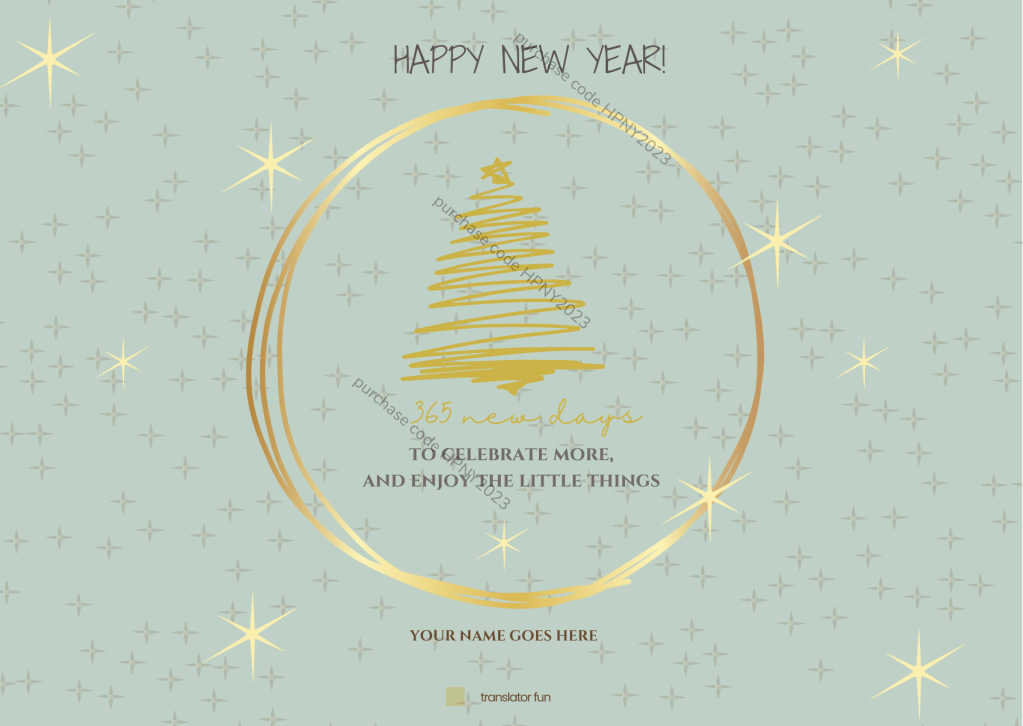
If you are into embracing new beginnings and opportunities, these are the right inspirational cards to send to welcome 2023. These cards share the hopeful and cheerful spirit for a bright and promising future and act as a reminder of the beauty of small things.
These cards are customizable (your name and logo and be added), so you can use them as a marketing tool to promote your services for the upcoming year and share your love while doing so.
Wishing you a wonderful end of the year and an even better 2023. Peace.
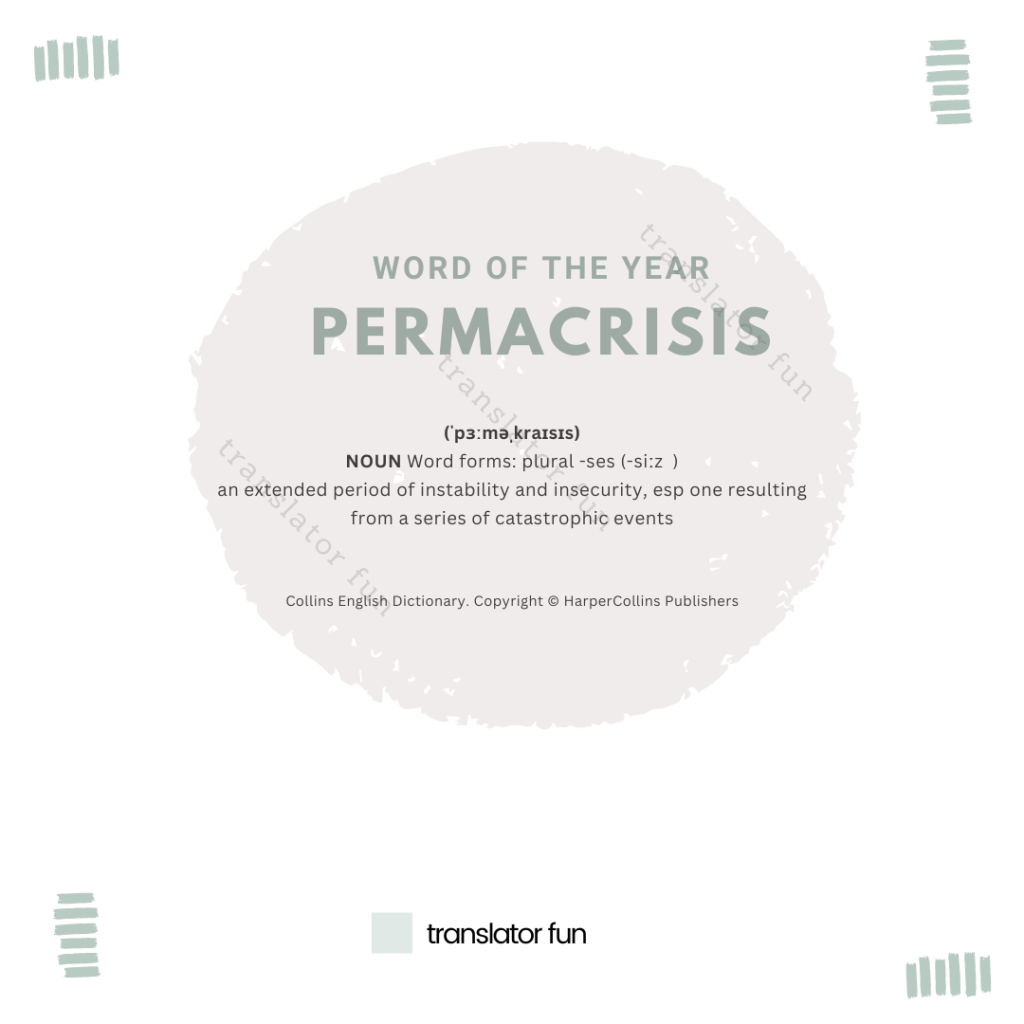
Collins dictionary has chosen “permacrisis” as the word of the year 2022. The word is used to describe an extended period of instability and insecurity, esp one resulting from a series of catastrophic events.
Permacrisis tops a list of 10 words, six of them new entries in the dictionary, which represent 2022, Collins said.
“Language can be a mirror to what is going on in society and the wider world, and this year has thrown up challenge after challenge.
“It is understandable that people may feel, after living through upheaval caused by Brexit, the pandemic, severe weather, the war in Ukraine, political instability, the energy squeeze, and the cost-of-living crisis, that we are living in an ongoing state of uncertainty and worry.”
Collins Dictionary monitors its 18bn-word database and a range of media sources, including social media, to create an annual list of new and notable words. Source The Guardian
Be warned: whenever you ask a translator about the meaning of a word they will inevitably say “it depends on the context.”
The things-translators-always-say series is inspired by the group on Facebook Things Translators Never Say created by Erik Hansson. This series aims to depict phrases and things translators openly say.









 Translator Fun