
Multitasking — click on the image to enlarge
 Purchase code “MULTITASKING”
Also, see this cartoon in Spanish.
—
Do you like Translator Fun? Become a sponsor or show your support with a donation.

Multitasking — click on the image to enlarge
Purchase code “MULTITASKING”
Also, see this cartoon in Spanish.
—
Do you like Translator Fun? Become a sponsor or show your support with a donation.

Friend’s day in Argentina
Also, see this post in Spanish>>
Today, July 20th, we celebrate Friend’s Day here in Argentina. On this day long-standing friends get together in bars, restaurants or at someone’s place to have dinner and honor their friendship.
So I wanted to celebrate Friend’s Day with my fellow translators and made a cartoon about it. I hope you like it!
You can follow tweets related to this day with the hashtag #amigo on Twitter.
Romina
Do you like Translator Fun? Subscribe to Translator Fun’s YouTube channel

Follow me — click on the image to enlarge
See this article in Spanish and French>>
Also see:
On Twitter if someone follows you it means that your Twitter updates will appear on your followers’ Twitter home page every time you post a new message. Being followed increases your chances of having your tweets retweeted by others and eventually gain more followers. Your number of followers and the number of times your tweets get retweeted help to build your Twitter reach. (see this article on Freelance Switch with a list of tools for analyzing your Twitter stats) However, there is a way in which you can make your tweets reach more people other than your followers. When you use hashtags, which are “a community-driven convention for adding context and metadata to your tweets created by simply prefixing a word with a hash symbol, e.g. #hashtag” you are broadening the reach your tweets since all those on twitter who are following that certain hashtag will be able to see your tweet. Hashtags were developed as a means to create “groupings” on Twitter, without having to change the basic service. As mentioned in my previous post, the hashtags used for translation are #xl8 and #t9n, #L10n is the one used for localization and #flinternet refers to “foreign language Internet”. Since hashtags are a convention among Twitter users anyone can create a new hashtag. This is particularly the case for events: a new hashtag is created to tag the news related to that event. It is also very likely that these type of hashtags fall soon into disuse (i.e. as soon as the event is over or a little after that). Some examples of hashtags specially created for events are: #smday for “Social Media Day” celebrated on June 30, 2011 and #lwbar for “Localization World Barcelona”. So if you are interested in following an event on Twitter you should try to find out which hashtag is being used. As you may have realized by now, having many followers is seen as a positive indication of the person’s influence and the relevance of the content of their tweets. I guess this is why everyone on Twitter is so fond of the “Follow me” phrase. So if you like this post and my comic follow me… but only on Twitter! Romina
 Twitter overdose — Click on the image to enlarge
See post in Spanish and French >>
Also see:
Twitter is a social networking service that allows you to answer the question “What are you doing?” by sending short text messages of 140 characters or fewer called “tweets” to your friends, colleagues or “followers”.
Interactions on Twitter are faster and you can communicate with anyone you want by simply typing “@ plus their username” on the text area (email addresses are no longer needed!)
Many professionals are now using Twitter to market their businesses, stay informed and network. As I mentioned in this article, translators seem a little reluctant to start using Twitter as a marketing tool to help them grow their businesses (see these ProZ.com poll results from 2009 and 2010). However, the number of translators and language professionals using Twitter is growing. Some blogs and sites have published lists of their favorite language Twitterers (see The Global2Local current top 5 Favorites on Twitter! and Jared’s list of his favorite ones on Twitter for translators?). Even a competition to choose the Top 25 language Twitterers was held in May 2011. The top 25 language twitters are listed here.
To start “hearing” what your colleagues are tweeting about translation and localization make sure you follow tweets with these hashtags: #xl8, #t9n and #L10n.
If you would like to get some tips on what to tweet and some ideas on twitter timing read this useful article on Social Media Tactics for Translators: Twitter by Silvina Jover-Cirillo.
As for myself, my experience with Twitter has been very rewarding so far. I could see for myself that using Twitter for one’s professional career has many benefits as my colleagues had indicated. My tweeting practice has given me the opportunity to meet colleagues, stay informed about translation-related news, articles, webinars, tools, products and features and to be contacted for work opportunities.
See you on Twitter!
You can follow me @Romina_Bona and @TranslatorFun of course!
Recommended further reading: 5 Ways NOT to Use Twitter for Freelancers

Backup -- click on the image to enlarge
On backups: According to Wikipedia, the primary purpose of backups is “to recover data as a reaction to data loss, be it by data deletion or corrupted data. Data loss is a very common experience of computer users. 67% of internet users have suffered serious data loss.”
Translators are among those computer users whose work may be lost in a matter of seconds. Some translators often forget to make a backup of their files and this may harm their productivity and put them in an unpleasant situation when it comes to meeting the deadline. Making periodic backups should be considered a best practice for translators.
When was the last time you made a backup of your files?
___________________________________________________________________________________________
Note: I originally created this comic for the ProZ.com Translator Playground (this is an improved version).
Some colleagues have come up with nice suggestions (some are even better than mine!) ProZ.com is now running a competition to choose the best among the suggestions. If you would like to vote you can do so here.
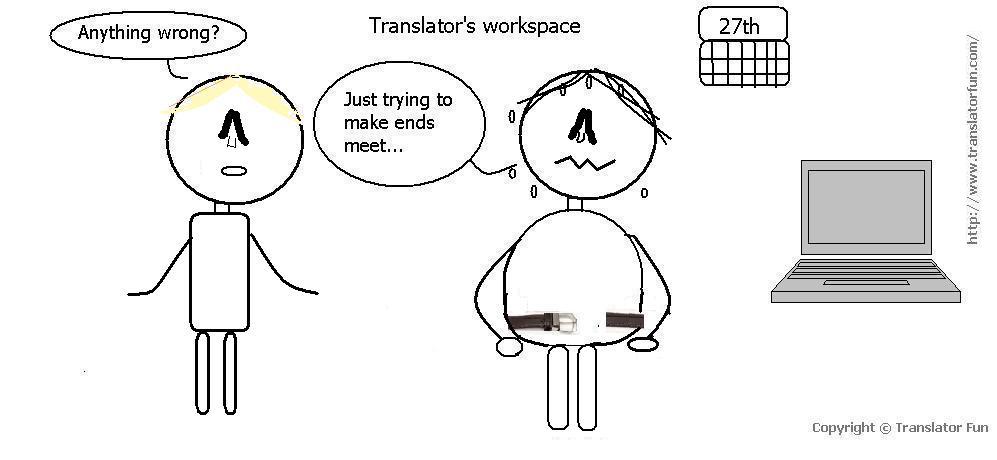
making ends meet -- click on the image to enlarge
Translating idioms is one of the many challenges translators face on their work. According to the Collins Cobuild dictionary: “an idiom is a group of words which, when they are used together in a particular combination, have a different meaning from the one they would have if you look the meaning of all the individual words in the group”.
Translators should be aware of the meaning of idioms and avoid translating them literally.
Challenge: how would you translate this comic into your source language (provided it is not English, of course) and keep it funny?
Happy translating!
Romina
Welcome to Translator Fun — a blog for translators willing to share fun ideas and translation challenges.
I’ve decided to start this blog to bring together my passion for translation and my never-ending drive to have fun with what I do.
In this blog you will find comics which by no means depict a drawing talent but are rather intended to reflect on translator’s jargon, working environment, plays on words and stuff.
I hope you enjoy this blog and find it a useful resource to chill out before, during or after work.
Thanks for reading.
Have fun!
Romina
You can follow me on Twitter: @Romina_Bona and @TranslatorFun
Read this post in Spanish


 Translator Fun