[Guest Post]
As the world becomes more connected, interactions between people from different cultures, whether that be at school, at work or as part of daily life, are increasing. As a result of this, the translation industry is growing at an unprecedented rate and consequently, so are the number of translators!
Many times you might say to your translator, “you’re a life-saver” or “you are irreplaceable” or “I couldn’t have completed that business deal without you”, which are all great to hear. But here are a few things you perhaps shouldn’t say if you want to keep your translator sweet!
1. I just had my secretary write a 70-page document, can you quickly proofread it for me?
First of all, there’s nothing ‘quick’ about 70-pages. It’s easy for people to undermine a translator’s ability by assuming proofreading or translating a document is a walk in the park. What many fail to understand is that it takes years of learning, practice and commitment to become a good translator, and even at your best, you may still lose an hour of your day researching the perfect translation of a single word.
2. You are a translator, right? What does (insert random word with no context) mean?
Sure, translators are very skilled (almost superhuman may we add!) but that doesn’t mean they can translate every single language on Earth! Additionally, many languages, including English, have words with multiple meanings. We can guarantee that a translator’s first response to a question such as this would be “what’s the context?”
3. I took French in high school and was looking for some work on the side, could you help me get into the industry?
We understand. It’s natural for people to think that all it takes to become a translator is basic knowledge of a language, but being a translator is so much more than that. It’s one thing being able to understand what someone has said in a foreign language, but being able to convey that in another is a form of art. Plus, if everyone who took French in high school became a translator, why are some earning up to $100 an hour?
4. What! So you translate from home? Is that an actual job?
Yes, it is. Do you think there’d be a multi-billion dollar translation industry otherwise?
5. Wait, what? $(fill in the blank) for a job that will literally take a few hours to translate? I’ll use Google Translate instead!
Translators hear this many times over the course of their careers and it’s never nice to feel like your time and abilities are being undermined. But, again, a multi-billion dollar translation industry wouldn’t exist if Google Translate were accurate. Give it a go, we guarantee you’ll be back!
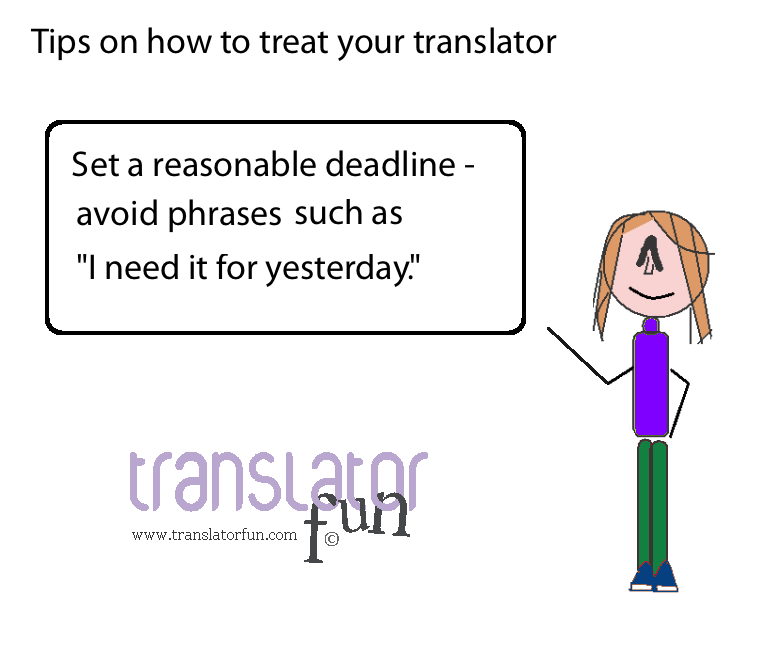
6. There’s no way it can take that long! I needed this yesterday! It’s only 25 pages long, a day is surely more than enough.
Translation is not an easy job, and sometimes it can take a long time. If translation were merely swapping words from one language to another then hey, it would be easy (and even Google Translate could do a good job). It’s not, though. It involves assessing the context, understanding the background of a word or phrase, maintaining a tone, localising a concept… the list goes on. And it’s for this reason that it takes about an hour to translate a one page document. So, yes, perhaps a day would be enough if they don’t eat, sleep, go to the bathroom, have a life etc.
7. So, I had my friend look over the document you translated. She speaks French and doesn’t think it’s very good.
If you have a friend, aunty, cousin, grandpa that you wholly trust to do your translation work for you, then why seek the services of a professional? Enough said!
8. We need you to translate a super confidential document and can only send it after we agree a price. How much will you charge?
Think of this from a practical perspective: how is a translator supposed to assess the scope of the work if they can’t see the document? This is like asking a landscaper to transform your garden, but not letting them see it first. A 300-word translation of a contact form is very different to the translation of a 300-word document on ventilation cowls for the upward discharge of hot air in sustainable buildings…
9. I need you to maintain the formatting in this scanned JPEG file I’m sending you to translate.
A language is a hard enough skill to learn without having to understand the ins and outs of graphic design. They are two completely separate jobs and should be treated as such. If you’re lucky enough to come across a translator willing to do both, you should expect them to ask to be compensated accordingly. Otherwise, hire a graphic designer to either create an editable copy of the file in the first instance, or ask them to amend the formatting once the translation has been completed.
10. Can you please give me a quote to translate my website www.(ridiculousnumberofpages).com?
Typically, website translations are high-volume, so make sure you have a high budget! Don’t expect a translator to spend hours of their day clicking through URL by URL trying to figure out the content to translate just for you to refuse their quote. Help them out by sending a list of the URLs to be translated, or even better, export the content into an Excel file.
To conclude,
Be kind. Avoid demeaning comments, unrealistic expectations, and be courteous to your translator. It’s by no means an easy job, even for the most skilled of translators.
On the other hand, if you are a translator, try to remain calm and positive. Most of these questions are due to not fully understanding the true cost of a quality translation. Eventually, you will find it pretty funny and get a good laugh out of it!
Find out more on Espresso Translations translation services.
*********
Do you like Translator Fun? Become a sponsor or have your guest post featured.
Show your support of Translator Fun. Donate now.