Happy International Translation Day: Why Human Translators Will Always Win

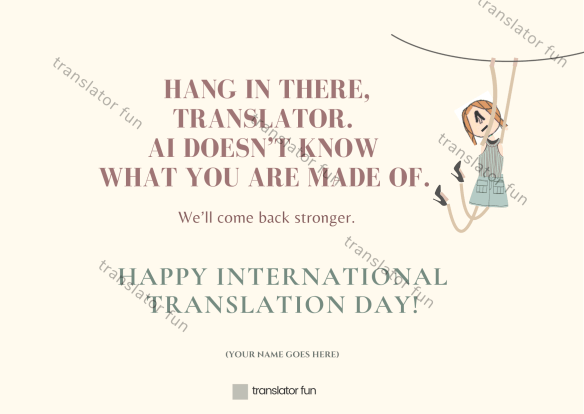
Female translator hanging in there
International Translation Day
Buy Now Button

Purchase code: ITD25

To the Invisible Architects of Global Understanding

September 30th is the day we pause to celebrate the incredible, invisible work that translators, interpreters, and terminologists do every single day.

From helping businesses navigate international waters to bringing the world’s greatest literature to new audiences, our work is a foundational pillar of global communication.


The Storm of Change: Hanging in There in the Age of AI

We know the conversation right now is dominated by two letters: AI. It’s creating turbulence, uncertainty, and a feeling that the ground is shifting beneath our keyboards. If you’ve felt discouraged, anxious, or pressured by the rise of machine translation, you are not alone.

But here is the truth we must hold on to: The advance of AI is not a death sentence for human translators. It is a new chapter that will force us to come back stronger, smarter, and more essential than ever before.

Our Unbeatable Human Edge

Machines can process data, but they cannot process life. Our strength lies in everything AI lacks—it’s the human touch we bring to every project.

What sets a professional translator apart?

  1. Cultural Depth and Background: We don’t just translate words; we translate worlds. Our vast life experience and deep understanding of cultural context, nuance, and subtext allow us to choose the right word, not just the possible word. We prevent the embarrassing, sometimes dangerous, mistake that a literal engine misses.
  2. The Power of Nuance: We understand irony, tone, metaphor, and the unspoken intention behind a phrase. We know how to make a text sound natural, authentic, and perfectly suited for its target audience. This is creativity, and it’s irreplaceable.
  3. Ethical Responsibility: Whether it’s a legal contract, a medical report, or a literary work, we operate with a professional and ethical integrity that guarantees clarity, accuracy, and trust.

The future of translation is not about replacing us; it’s about partnering with us. Human expertise will be critical in training the machines, refining their output (Post-Editing), and handling the high-stakes, high-nuance projects that only a true expert can manage.

Hang in there, translator. The world needs our unique background and insight now more than ever. We are the quality control, the cultural gatekeeper, and the ultimate arbiter of meaning.

Celebrate Our Community—Send a Card!

Translation can often feel like a solitary job, spent alone with our screen, glossary, cat and coffee. But today is a reminder that we belong to a vibrant, global community of dedicated language lovers.

Let’s use International Translation Day to celebrate our colleagues and show some solidarity!

As a fun and simple gesture of appreciation, consider sending a digital card to your fellow translators. The International Translation Day cards available on Translator Fun are the perfect way to share a laugh among colleagues.

A simple card can brighten a colleague’s day, acknowledge their struggle, and remind them that we are all in this rewarding, challenging profession together.

To all the linguists out there: Happy International Translation Day! Keep rocking those glossaries, keep fighting for the perfect phrase, and know that our work makes the world a better, more connected place.

Buy the International Translation Day card here!

*******

Do you like Translator Fun? You can become a sponsor or have your guest post featured.

AI in the Translation Sector: Friend, Foe, or Secret Teammate?

[Sponsor’s guest post]

🤖 AI in the Translation Sector: Friend, Foe, or Secret Teammate?

The translation industry has always been a fascinating crossroads of language, culture, and technology. From the earliest days of bilingual dictionaries to the advent of machine translation, every new tool has reshaped the profession. Now, Artificial Intelligence (AI) is the latest player to step onto the stage—and it’s hard to ignore its impact.

🚀 The Rise of AI in Translation

With the rapid development of neural machine translation systems, AI has moved beyond clunky word-for-word renderings. Tools like DeepL, Google Translate, and countless custom-built engines can now produce surprisingly fluent drafts. For many, this feels like magic: input text on one side, receive a nearly publish-ready version on the other.

But is it really that simple? Not quite. AI can certainly speed up workflows, but it struggles with nuance, cultural sensitivity, and the highly specific requirements of certified or notarized translations. Anyone who has asked AI to handle a complex legal contract or a medical report knows it: the results can range from amusing to alarming.

🎭 Translators in the Age of AI

So, what does this mean for professional translators? Instead of pushing human experts aside, AI is becoming more of a teammate. Think of it as the enthusiastic intern: fast, eager, and tireless—but in desperate need of supervision.

Human translators bring what AI cannot replicate:

  • Contextual understanding (knowing when “bank” means a financial institution vs. the edge of a river).
  • Cultural sensitivity (catching idioms, humor, and subtle tones).
  • Legal and official accuracy (ensuring certified translations meet notarial and governmental standards).

In short, AI drafts, but translators perfect.

🏛️ When Machines Meet Ministries

One area where AI’s limits become crystal clear is in official translation and attestation. Governmental approvals, apostille procedures, and embassy verifications demand precision, certification, and human accountability. No AI-generated stamp is going to pass at the Ministry of Foreign Affairs.

Agencies like the Turkish Translation & Attestation Agency (TTAA) emphasize this balance beautifully. While technology assists in efficiency, it’s human expertise—and the trusted agency’s official seals—that guarantee documents are legally valid abroad.

😂 A Lighter Note

Let’s be honest: every translator has had at least one good laugh at AI’s expense. Some classics from community forums include:

  • “Marriage certificate” translated as “wedding coupon.”
  • “Seal of approval” rendered as “animal of applause.”
  • And the eternal favorite: mistranslations that read more like abstract poetry than legal text.

These moments remind us that while AI is impressive, it still has a long road before replacing the artistry of human translation.

🌍 Looking Ahead

The future isn’t about humans versus machines—it’s about collaboration. Translators who embrace AI as a productivity tool will thrive, freeing themselves from repetitive tasks and focusing on higher-value work. Clients, meanwhile, will continue to rely on professional translation agencies like TTAA for the gold standard: translations that are fast, accurate, and officially recognized worldwide.


Final Thought:
AI may speak in many tongues, but only human translators know how to listen between the lines.

*******

Become a sponsor or have your guest post featured.

Show your support of Translator Fun. Donate now.

How the Tomedes Pre-Translation Toolkit Enhances Translation Accuracy

[Sponsor’s guest post]

Accurate translations are essential for clear communication across languages, which is important for global business, cultural exchange, and international teamwork. Even a small mistake in translation can cause serious problems like misunderstandings, damage to reputation, or legal trouble. To tackle these issues, Tomedes created the Pre-Translation Toolkit, a complete solution to make translations more accurate and efficient.

By addressing common pain points early in the translation process, the Pre-Translation Toolkit offers a structured approach to tackling the complexities of multilingual content. This article explores this toolkit’s components, features, and benefits, highlighting how it redefines the standard for professional translations.


What Is the Tomedes Pre-Translation Toolkit?

The Pre-Translation Toolkit is a comprehensive suite of tools designed to optimize the initial stages of translation projects. These tools address essential pre-translation tasks, including language identification, topic analysis, terminology extraction, and complexity assessment. By automating these processes, the toolkit significantly reduces the likelihood of errors and ensures that translation workflows are both efficient and reliable.

The toolkit is not limited to professional translators; it benefits localization experts, content creators, and businesses preparing materials for international audiences. With its versatile features, the toolkit adapts to the unique requirements of various industries, providing tailored support for projects of all sizes.


Components of the Toolkit

1. Language Detector

Identifying the language(s) present in a source text is fundamental to initiating an accurate translation. The Language Detector quickly and reliably determines the language, eliminating any guesswork.

Applications:

  • Businesses managing multilingual customer interactions can ensure accurate responses in the correct language.
  • Software platforms requiring localization can align projects with appropriate translation engines or experts.

Key Impact: 

This tool streamlines the project setup phase, reducing delays caused by language misidentification and ensuring that the text is matched with the appropriate translator or machine translation engine.


2. Topic Detection Tool

Understanding the subject matter of a source text is essential for ensuring the translation aligns with the intended context. The Topic Detection Tool analyzes the content and identifies its primary subject, making it easier to assign projects to specialized translators or MT engines.

Industries Benefited:

  • Healthcare: Translating medical reports and clinical research documents accurately requires subject matter expertise.
  • Finance: Financial documents, including annual reports and compliance records, demand precision, and contextual understanding.
  • Legal Services: Contracts, legal briefs, and court documents must adhere to strict terminologies and legal conventions.

By pinpointing the topic, this tool ensures that the translator or engine selected has the necessary expertise, reducing errors and maintaining relevance.


3. Key Terms Glossary

Consistency in terminology is a hallmark of high-quality translation, particularly in technical fields or branding projects. The Key Terms Glossary identifies critical terms in the source text and provides a framework for ensuring their consistent use throughout the project.

Why It’s Important:

  • Industries like pharmaceuticals, engineering, and software development rely on precise terminology to maintain clarity and avoid misinterpretations.
  • Brand-specific terminology ensures that marketing materials retain their intended message and tone across languages.

Example: 

A software company launching a global campaign can ensure that technical terms, product names, and user interface labels remain consistent across all translations.

4. Source Text Checker

Poorly written source texts often lead to inaccuracies in translation. The Source Text Checker reviews the original text for grammatical errors, ambiguous phrasing, and structural inconsistencies, offering actionable feedback to improve its quality before translation begins.

Benefits:

  • Reduces misunderstandings caused by unclear or erroneous source material.
  • Saves time by addressing potential issues early, and minimizing revisions later in the process.

This tool ensures that the source text provides a solid foundation for translation, ultimately improving the accuracy and fluency of the final output.

5. Translation Difficulty Checker

Translation projects vary significantly in complexity. The Translation Difficulty Checker analyzes the text’s linguistic challenges, such as idiomatic expressions, technical terminology, and sentence structure, to recommend the most suitable translation approach.

Applications:

  • AI Translation: 

Suitable for routine documents such as internal reports or emails.

  • Human Transcreation: 

Necessary for creative content, such as marketing campaigns or literary works.

Key Outcome: 

By matching the complexity of the text with the right translation method, this tool ensures both cost efficiency and high-quality results.


How the Toolkit Increases Translation Accuracy

  • Streamlined Preparation

The Pre-Translation Toolkit automates labor-intensive tasks, reducing the manual effort required during the preparation phase. Translators can focus on refining the content rather than resolving preliminary issues, leading to faster and more accurate results.

Outcome: 

Automation not only saves time but also ensures that the translation process starts on a strong foundation.

  • Improved Consistency

Consistency in translation is critical, especially for large-scale or collaborative projects. Features like the Key Terms Glossary help maintain uniformity across all aspects of a project.

Example: 

A global brand managing campaigns in multiple regions can ensure that its messaging remains coherent and culturally appropriate in all target languages.

  • Faster Turnaround Times

By streamlining the preparation phase, the toolkit enables quicker project completion without sacrificing quality.

Impact: 

Businesses can meet tight deadlines with confidence, ensuring that their materials are both accurate and timely.

  • Enhanced Collaboration

The insights provided by the toolkit can be shared among teams, ensuring alignment on key terms, topics, and project goals before translation begins.

Use Case: 

A localization team preparing a multilingual marketing campaign can align on key terminology and tone, reducing the likelihood of inconsistencies.


Traditional Workflows vs. Toolkit-Driven Processes

Traditional translation workflows often involve manual reviews and preparations, which can be time-consuming and prone to errors. Common challenges include:

  • Identifying ambiguous or poorly written source text.
  • Ensuring consistent use of terminology across documents.
  • Addressing formatting or structural issues in the source material.

The Tomedes Pre-Translation Toolkit automates these tasks, offering a scalable and efficient alternative to traditional methods:

  • Traditional Processes: 

Time-consuming, inconsistent, and prone to human error.

  • Toolkit-Driven Processes: 

Automated, precise, and adaptable to diverse project needs.


Conclusion

The Tomedes Pre-Translation Toolkit represents a significant advancement in translation preparation, addressing common challenges with innovative tools that prioritize accuracy and efficiency. By integrating solutions like the Language Detector, Topic Detection Tool, and Translation Difficulty Checker, the toolkit empowers translators, localization experts, and businesses to deliver high-quality translations tailored to their needs.

Whether preparing marketing materials for global audiences, translating technical manuals, or localizing software, the Pre-Translation Toolkit simplifies and enhances the process, ensuring reliable results every time.

Explore the Pre-Translation Toolkit to see how it can elevate your translation projects, improving consistency, accuracy, and collaboration at every stage.

*******

Become a sponsor or have your guest post featured.

Show your support of Translator Fun. Donate now.
Breaking the AI Myth: Why Human Translators Will Always Be Essential

[Sponsor’s guest post]

This article will take a deep dive into the misconception that AI will replace human translators. It will provide data and insights into why AI can never fully replace the nuanced understanding and cultural knowledge that only humans bring to translation.

Breaking the AI Myth: Why Human Translators Will Always Be Essential

The rise of artificial intelligence (AI) has led to a widespread belief that human translators are on their way out, destined to be replaced by intelligent algorithms. But is this really the case? 

In this article, we’re going to debunk this myth, explaining why human translators are still and always will be essential. We’ll explore the nuances of translation that require a human touch. You’ll also see how AI is enhancing the role of professional linguists instead of replacing them.

The rise of AI in translation

AI translation technology has advanced from simple rule-based systems to sophisticated Neural Machine Translation (NMT), making translation faster and more accessible. Tools like Google Translate and DeepL offer quick, often accurate translations across many languages.

Despite these improvements, AI still falls short in understanding context, cultural nuance, and emotion. As Rachelle, Head of AI at Tomedes, says, “AI has transformed translation but can’t replace the cultural and contextual insights humans bring.” Human translators remain essential for adding the depth that AI alone cannot achieve.

AI and human translators’ collaboration can enhance the quality

Many think AI and human translators are in competition, but the best results happen when they work together. Picture AI as the rhythm in an orchestra, setting the basics, while human translators are the soloists, adding depth and nuance.

In translation, AI can handle repetitive tasks like drafting translations or processing large volumes of text, freeing human translators to focus on creativity, context, and emotional tone. For instance, AI might translate a technical manual, while a human ensures that safety warnings are adapted to each culture’s urgency and seriousness.

This partnership boosts efficiency for freelancers and in-house teams. It lets translators concentrate on making language vibrant and meaningful.

The Case for Free AI Tools in Translation

Free AI tools are transforming the translation industry by providing advanced technology at no cost, enabling smaller players to compete with larger Language Service Providers (LSPs).

Benefits of Free AI Tools:

  • Cost Savings: Freelancers and small businesses can reduce expenses by using free tools like MachineTranslation.com, allowing them to be more productive without the high costs of traditional software.
  • Accessibility: These tools provide small players with the same technology as large LSPs, enabling them to deliver high-quality translations and compete effectively.
  • Efficiency: Free AI tools automate repetitive tasks, letting translators focus on complex aspects of translation, increasing both productivity and quality.
  • Scalability: Small businesses can easily expand their capacity, using AI for first drafts and humans for refinement, managing higher demand without compromising quality.
  • Inclusivity: Free AI tools remove financial barriers, making advanced technology accessible to all and fostering a more inclusive industry.

How Tomedes is leading the way in free AI translation tools

Tomedes is setting a new standard with free AI-powered translation tools that boost efficiency without financial strain. Tools like MachineTranslation.com and AITranslator.com streamline repetitive tasks, letting translators focus on high-quality refinement. Freelancers and small translation companies now have the tech to compete with large Language Service Providers (LSPs), efficiently handling high-volume projects and serving global clients.

Our free AI translation tools empower freelancers and small companies to produce initial drafts quickly, especially for large projects like website translations, while human review ensures cultural accuracy and quality. However, while AI is valuable for routine tasks, human oversight remains essential for specialized or nuanced content. Translators should use AI tools as aids, not replacements, especially for complex projects that demand cultural and emotional precision.

As AI technology evolves, free tools will offer even more sophisticated support. By balancing AI’s speed with human expertise, translators can deliver accurate and resonant work, ensuring the best outcomes for clients and pushing industry standards forward.

How AI improves translation efficiency and reduces operational bottlenecks

Translation projects often face bottlenecks, especially in high-volume, multilingual tasks. Here, AI can greatly improve efficiency. By automating initial drafts, AI reduces timelines from days to minutes, giving translators more time to refine accuracy. Project managers can quickly assign drafts, speeding up workflow and ensuring consistency.

Corporate localization teams also rely on AI for efficiency, especially when translating large volumes like product descriptions across many languages. AI handles the initial translation, allowing human translators to refine it for cultural fit and brand tone. This blend of AI speed and human skill results in faster, more accurate, and cost-effective translations that meet deadlines without compromising quality.

The unmatched value of human cultural insight and emotional understanding

Human translators stand out for their cultural insight and ability to convey emotion. Language reflects culture and history, and while machines can translate words, they often miss the emotional depth. For example, “It’s raining cats and dogs” means heavy rain, something a human understands while AI might misinterpret without context.

Human translators excel at capturing the right tone and adapting content for cultural relevance. In business emails or customer support, they ensure the tone is suitable—professional yet empathetic. In literature, translators bring creativity to make the work resonate, capturing nuances that AI cannot. For ads, human translators adjust humor and references to fit regional norms, ensuring messages land appropriately without offending.

Why human oversight is critical in addressing AI’s limitations

AI translation tools have undeniably advanced, but they still have significant limitations that necessitate human oversight. Here are some of the most critical challenges of AI in translation:

1. Mistranslations with serious consequences

AI tools can create mistranslations with serious consequences, especially in healthcare and law. Accurate translation of patient info, dosage instructions, or legal terms is vital. Mistakes here could lead to incorrect treatments, legal issues, or regulatory problems, risking lives and businesses. Human oversight is crucial for accuracy and safety.

2. Inability to understand evolving language trends

Language is always changing, with new slang and expressions constantly emerging, especially from social media. Human translators adapt to these shifts faster than AI, which often lags behind. This quick adaptation is crucial in fields like marketing and media, where relevance is key. AI struggles with evolving language, so its translations may not connect well with modern audiences.

3. Difficulty with ambiguity

Many languages have words with multiple meanings, and AI often struggles to pick the right one without context. For example, “bank” can mean a financial institution or a river’s edge. Without context, AI might choose the wrong meaning, leading to confusion. Human translators use intuition and context to ensure accurate and clear translations, avoiding costly mistakes.

4. Lack of cultural sensitivity

AI can’t grasp cultural nuances, which are essential in content like marketing, literature, and PR. Human translators ensure content is culturally appropriate, resonating with audiences and avoiding offense. For example, an ad slogan might work well in one culture but be confusing or offensive in another. Only human translators can adapt content to be effective and respectful across cultures.

5. Limited ability to convey emotional tone

Language conveys emotions, intent, and tone, not just words. AI tools may translate words accurately but often miss the original emotional tone, especially in literature, poetry, and marketing. A heartfelt message might come across as robotic, losing its impact. Human translators capture the intended emotion, ensuring the message resonates with the audience.

6. Challenges with specialized terminology

In fields like law, medicine, engineering, and finance, precise translation of specialized terms is essential. AI tools may struggle with complex, industry-specific vocabulary. While AI can help with initial drafts, only expert human translators ensure correct, consistent terminology. Misinterpreting a technical term could lead to misunderstandings, compliance problems, or safety risks.

7. Contextual awareness

AI lacks true contextual understanding. While it has improved through machine learning, it still can’t match human comprehension. Context is crucial for translating idioms, metaphors, and unique phrases. Human translators use their experience, cultural knowledge, and context to ensure translations capture the original message accurately.

8. Ethical considerations and bias

AI systems, trained on large datasets, can sometimes learn and reflect biases, leading to biased or inappropriate translations on sensitive topics like gender, race, or culture. Human translators can spot and correct these biases, ensuring translations are fair and sensitive. Relying only on AI risks perpetuating stereotypes or causing unintentional harm.

Conclusion

AI has transformed translation, making it faster and more cost-effective, especially for basic tasks and large volumes of text. However, human translators remain essential, bringing cultural understanding, emotional intelligence, and the ability to convey the true essence of the original message. At Tomedes, we combine AI’s efficiency with human expertise to offer tailored language solutions that meet unique needs. 

*******

Become a sponsor or have your guest post featured.

Show your support of Translator Fun. Donate now.

Celebrate International Translation Day

Coffee day for translator
Translation day means coffee day
Buy Now Button

Purchase code: Coffee

On this special day, we celebrate a profession that bridges cultures, connects people, and makes the world a smaller place—Happy International Translation Day! Today is all about recognizing the hard work, dedication, and skill you all bring to the table (and the coffee shop, let’s be honest!).

As you go about your day, take a moment to celebrate the incredible impact you have on communication. Whether you are transforming complex legal documents into accessible language or helping a business navigate international waters, your expertise is invaluable.

Why not take a little break today to exchange cards with your fellow language enthusiasts? A simple gesture can brighten someone’s day and strengthen those essential connections within our community.

Speaking of coffee, it’s no secret that many translators and interpreters rely on a steady stream of caffeine to power through those late-night deadlines and endless glossaries. So, in honor of this special day, let’s raise our mugs (or cups, or thermoses) to one another and celebrate our shared love for language—and coffee, of course!

In the spirit of camaraderie and caffeine, the next round is on me. Just make sure you don’t spill it while you’re translating!

Cheers to all of you, and happy International Translation Day! Let’s keep translating the world, one sip at a time!

Drink up.

Buy Now Button

Purchase code: Coffee

********

Become a sponsor or have your guest post featured.

You can also send a small donation to show your support and encourage Romina to keep creating fun stuff. Donate now.

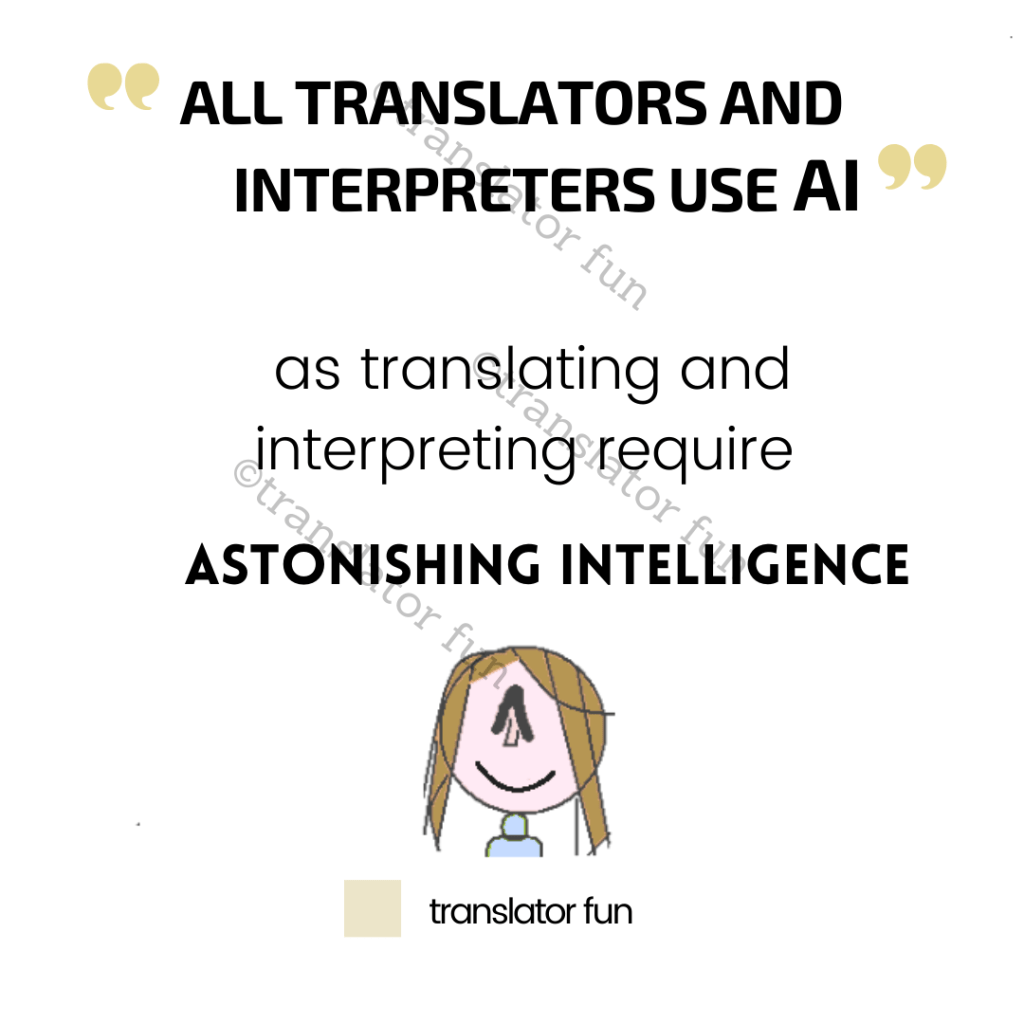
100% of translators and interpreters use AI

translating and interpreting require AI
AI is inherent in all translators and interpreters.
Buy Now Button

Purchase code: AI

There! I’ve said it. I believe 100% of translators and interpreters use their AI to work. Being a translator or an interpreter requires intelligence that can be described as astonishing or awe-inspiring. The experience of inhabiting two or more worlds simultaneously is awe-provoking. Translators and interpreters can see the world in one language and then switch to a different language to convey what they’ve just seen, read, and heard.

The more I think about it, the prouder I get. As I see it, AI is inherent in all translators and interpreters. Don’t you agree?

********

You can also send a small donation to show your support and encourage Romina to keep creating fun stuff. Donate now.

Human Touch: Why Certified Interpreters Trump Automated Solutions

[Guest post]

In the ever-evolving landscape of communication where borders are increasingly becoming blurred, the need for effective language interpretation has never been more critical. While technology has made remarkable strides in automated translation solutions, there remains an undeniable truth: human touch, particularly in the form of certified interpreters, holds unparalleled value. Join us as we explore why, in the realm of language interpretation, the skills, empathy, and cultural understanding of certified interpreters continue to outshine automated alternatives.    

Navigating Nuances Beyond Words:

Language is not just a string of words, but a living, breathing entity imbued with cultural nuances, emotions, and context. Certified interpreters possess the ability to navigate these intricate layers, going beyond literal translations to capture the essence of communication. Automated solutions, while effective, often struggle to grasp the subtleties of human expression, leading to potential misunderstandings and misinterpretations.

Cultural Sensitivity and Contextual Understanding:

Certified interpreters are trained not just in languages but also in cultural dynamics. They understand the importance of context, cultural nuances, and the impact of non-verbal cues. In contrast, automated solutions lack the depth of cultural insight required for accurate interpretation, potentially leading to miscommunication in sensitive situations such as legal proceedings, healthcare consultations, or international business negotiations.

The Art of Active Listening:

Effective communication is a two-way street, and skilled interpreters excel not only in translating words, but also in active listening. They pick up on tone, emotions, and unspoken cues, ensuring a more comprehensive and accurate interpretation. The human touch in active listening is a nuanced skill that contributes significantly to successful communication, fostering understanding and building trust.

Adaptability in Dynamic Situations:

Language interpretation often occurs in dynamic, fast-paced environments where quick thinking and adaptability are crucial. Certified interpreters bring a level of agility that automated solutions struggle to match. Whether navigating technical jargon, legal terminology, or emotional conversations, human interpreters can adjust their approach in real-time, ensuring seamless communication in various scenarios.

Preserving Privacy and Confidentiality:

Certain interactions require a high degree of privacy and confidentiality, such as legal consultations or medical appointments. Certified interpreters adhere to strict ethical standards and confidentiality protocols, providing a level of trust that automated solutions may struggle to guarantee. Human interpreters prioritize the protection of sensitive information, creating a secure environment for communication.

Holistic Approach to Communication:

Interpreting goes beyond mere language conversion; it involves understanding the cultural context, emotions, and intentions behind the words. Certified interpreters adopt a holistic approach, recognizing the humanity in communication. Automated solutions, lacking emotional intelligence, may miss crucial nuances, resulting in a transactional rather than relational communication experience.

The Ethical Dimension:

Certified interpreters operate within a framework of professional ethics, including impartiality, accuracy, and cultural sensitivity. They navigate ethical dilemmas with finesse, ensuring fair and unbiased interpretation. In contrast, automated solutions lack the moral compass and discernment required for ethical decision-making in nuanced situations.

Conclusion: The Irreplaceable Human Element in Interpretation

While technology continues to reshape the way we communicate, human touch remains irreplaceable in the realm of language interpretation. Certified interpreters bring not just linguistic proficiency but also empathy, cultural understanding, and adaptability to the table. In critical situations where effective communication is paramount, the art of interpretation thrives in the hands of certified professionals. As we navigate the future, it’s clear that while technology can enhance efficiency, the human touch in interpretation will continue to be a beacon guiding us through the complexities of global communication.

******

Do you like Translator Fun? Become a sponsor or have your guest post featured.

The Art of Translation: Navigating Cultural Nuances and Beyond

Professional translators are a powerful tool
Translation breaks down cultural barriers

[Guest Post]

Beyond the literal conversion of words, professional translators are entrusted with the delicate task of navigating cultural nuances, idiomatic expressions, and linguistic subtleties. Join us as we unravel the intricate world of translation, exploring its role in fostering cross-cultural understanding and transcending linguistic boundaries.

The Complex Dance of Cultural Nuances: A Symphony of Understanding

Translation is an intricate dance, that transcends linguistic borders to reveal the underlying harmony of cultural nuances. It’s more than transcribing words; it involves deciphering the cultural context that encapsulates those words. Idiomatic expressions, cultural references, and even humor are deeply embedded in the fabric of languages. Understanding and accurately conveying these nuances require not only linguistic proficiency, but also cultural fluency – the ability to interpret the unspoken layers of meaning unique to each culture.

The Impact of Cultural Accuracy on Global Communication: Bridging Worlds

In a world where businesses operate on a global scale, the importance of cultural accuracy cannot be overstated. Misinterpretation of cultural nuances can lead to misunderstandings, inadvertently offending audiences, and damaging relationships. Conversely, when handled adeptly, translation becomes a powerful tool for developing positive connections, breaking down cultural barriers, and opening doors to international collaboration. 

The Challenge of Idiomatic Expressions: Walking the Linguistic Tightrope

Idioms, proverbs, and colloquialisms are linguistic treasures that encapsulate the essence of a culture. However, they pose a unique challenge for translators. A direct translation may not capture the intended meaning, and attempting to translate word-for-word can result in confusion. Professional translators, armed with a deep understanding of both source and target cultures, navigate this linguistic tightrope, ensuring that the essence of the message remains intact. 

Strategies for Businesses: Navigating the Cultural Mosaic

For businesses aiming for global success, integrating cultural awareness into their translation strategy is paramount. 

Choose Accredited and Specialized Translators:

Opt for translators with recognized certifications in the languages relevant to your business needs.

Seek out specialists in your industry, ensuring they have a deep understanding of sector-specific terminology and nuances.

Prioritize Cultural Fluency:

Look for translators who are not only bilingual but also culturally fluent in both the source and target languages.

Assess their understanding of cultural nuances, idioms, and local customs to ensure accurate and culturally sensitive translations.

Establish Clear Communication Channels:

Foster open communication between your team and translators. Clarify project’s objectives, target audience, and any specific cultural considerations.

Create a feedback loop to address questions promptly and refine translations to meet evolving needs.

Provide Comprehensive Context:

Offer translators detailed background information about your business, products, and services.

Share the context of the translation project, including its purpose, target audience, and any cultural nuances that should be considered.

Build Long-Term Relationships:

Cultivate ongoing relationships with a select group of translators to ensure continuity and consistency in your communications.

Working with a dedicated team fosters a deeper understanding of your brand, industry, and specific translation requirements.

Embrace Localization Practices:

Understand the importance of localization to reach diverse markets. Tailor content to suit cultural preferences, regional variations, and linguistic nuances.

Localization goes beyond translation, considering factors such as date formats, units of measurement, and cultural references.

Stay Informed About Cultural Trends:

Stay abreast of cultural trends, social nuances, and evolving language usage in the regions where your business operates.

This awareness ensures that your translations remain relevant and resonate with your target audience.

Incorporate Diversity in Your Translation Team:

Foster diversity within your translation team to reflect the cultural richness of your target markets.

A diverse team can provide unique insights and perspectives that contribute to more nuanced and culturally sensitive translations.

By implementing these practical tips and strategies, businesses can not only choose the right translation partners but also facilitate effective collaboration that goes beyond language proficiency, ensuring culturally synergistic and impactful global communication.

Conclusion: Crafting a Global Narrative Through Culturally Proficient Translation

As businesses embark on their global journeys, the art of translation is poised to weave a tapestry of connection, ensuring that messages resonate authentically across linguistic and cultural landscapes. In the vast expanse of global communication, cultural proficiency becomes the compass guiding businesses toward successful collaborations, building bridges that transcend language to create a shared narrative of understanding and unity. Join us in celebrating the art of translation, where precision and cultural sensitivity converge to shape a future of interconnected possibilities.

******

Do you like Translator Fun? Become a sponsor or have your guest post featured.